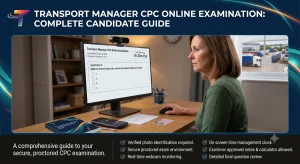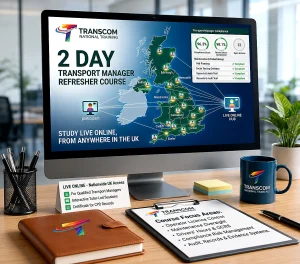
A transport manager’s name is not simply added to an operator licence. It represents a legally accountable role, with responsibility for keeping vehicles safe, drivers properly managed and transport operations compliant. An online transport manager CPC course gives aspiring and newly appointed Transport Managers a flexible route towards the recognised qualification, but the quality of the learning and support behind it matters.
The qualification is demanding for good reason. It tests whether a person can apply transport law, commercial judgement and practical compliance controls in the circumstances that arise within a real fleet. Passing the examination is the immediate objective. Being ready to protect an operator licence once appointed is the professional standard.
What an online Transport Manager CPC course involves
For most candidates, the relevant qualification is the Level 3 Certificate of Professional Competence in Road Haulage or Passenger Transport. The correct pathway depends on the type of operation you intend to manage. Haulage is for goods vehicle operations, while passenger transport covers bus and coach operations.
A properly structured online course covers the subjects a Transport Manager must understand and use. This includes operator licensing, drivers’ hours and working time rules, tachographs, maintenance systems, road safety, employment responsibilities, financial management and the legal duties surrounding international work where relevant.
The word ‘online’ should not be confused with unsupported self-study. A live tutor-led course gives learners a set timetable, the opportunity to question an experienced tutor and the discipline to work through difficult areas before they become exam problems. For many people balancing a job, fleet duties or family commitments, this makes qualification training more practical without reducing the expected standard.
Home-study can suit an experienced candidate with the time and confidence to plan their own learning. It is less suitable for someone new to transport legislation, anyone who has been away from formal study for some time, or candidates who need help interpreting case-study questions. The best route depends on your background, but every route should include clear materials, knowledgeable support and focused exam preparation.
Why the qualification is more than an exam requirement
The Traffic Commissioner expects an operator to have effective and continuous management of its transport activities. A qualified Transport Manager needs genuine authority, sufficient time and a close understanding of the operation. The role cannot be performed credibly by holding a certificate while someone else makes all the operational decisions.
That is why CPC learning needs to connect rules to evidence.
Consider vehicle maintenance. A learner may know that inspections must be carried out at planned intervals, but a competent Transport Manager also asks whether the interval is appropriate for the work, whether defects are reported and rectified, whether records are complete, and whether the system identifies missed inspections before they become a regulatory failure.
The same applies to drivers’ hours. Knowing the daily driving limit is only one part of the task. A Transport Manager must ensure work is planned lawfully, infringements are reviewed, drivers receive appropriate advice and recurring patterns are addressed. At audit or public inquiry, a policy on paper carries little weight without records showing that it is operating in practice.
For owner-operators and directors, this distinction is particularly important. Delegating day-to-day transport management does not remove the operator’s responsibility for licence undertakings. A well-trained Transport Manager provides oversight and challenge, but directors must still resource the operation properly and act when compliance concerns are raised.
Live online learning must create role readiness
A course delivered through a screen can be highly effective when it is designed for active learning rather than passive watching. Live sessions allow a tutor to explain difficult legal concepts in plain operational terms and use examples that mirror decisions made in a transport office, workshop or traffic desk.
Candidates should expect to work with calculations, scenario questions and case-study material. These are not distractions from the syllabus. They are how the examination assesses whether you can make reasoned decisions, identify risk and communicate an appropriate course of action.
For example, a case study may require you to respond to a driver’s repeated tachograph infringements, a missed safety inspection or a subcontractor arrangement that creates licensing risk. A strong answer does more than state the rule. It sets out the immediate action, the records to check, the people to involve and the controls needed to prevent recurrence.
That approach is valuable well beyond exam day. New Transport Managers often inherit imperfect systems. They need the confidence to identify what is missing, prioritise the greatest risks and present clear recommendations to an operator or director. Live tuition and direct tutor feedback can shorten that learning curve considerably.
Exam support is a practical advantage
The Transport Manager CPC examination requires careful reading, sound time management and answers that address the question asked. Candidates can lose marks by relying on broad statements rather than explaining actions, responsibilities and evidence.
Dedicated revision sessions, one-to-one guidance and practice questions help candidates understand where their knowledge is sound and where it is incomplete. This is especially useful for the case-study element, where the challenge is often application rather than recall. Support should build independence, not provide shortcuts. The person named on the licence must be able to make informed decisions after qualification.
Choosing the right course for your circumstances
Before booking, establish whether the provider delivers live teaching or simply supplies online materials. Both formats have a place, but they are not equivalent. Ask how questions are handled, whether tutor support is available between sessions, and how the course prepares candidates for both examinations.
It is also sensible to check that the training is delivered by a specialist provider with a practical grounding in operator licensing and road transport compliance. General training experience is not the same as understanding the pressures of managing defect reports, maintenance contractors, drivers’ hours investigations and licence undertakings.
Look closely at the course timetable. A condensed programme can work well if you can protect the study time and complete revision afterwards. If your operational workload is unpredictable, a programme with clear session dates, recorded learning where appropriate and additional support may be more realistic. Rushing the qualification because a vacancy needs filling can create a false economy.
Your choice should also reflect the role you are moving into. Someone joining an established, well-controlled fleet may need to focus on understanding existing systems and their personal responsibilities. An owner-operator applying for a first licence may need broader support with application requirements, financial standing, maintenance arrangements and compliance procedures. The CPC is central, but it is only one part of becoming operationally ready.
From qualified candidate to effective Transport Manager
After passing, the learning should continue. Regulations, enforcement priorities and the operation itself change. Refresher CPD helps qualified Transport Managers keep their knowledge current, while compliance health checks and audits can test whether systems still match the commitments made to the Traffic Commissioner.
The first months in post are a good time to establish a disciplined routine. Review inspection planning, defect reporting, driver licence checks, tachograph analysis, infringement follow-up, training records and document retention. Make sure responsibilities are clear when you are absent, and report material risks to the operator early rather than waiting for a problem to escalate.
Transcom National Training approaches CPC preparation as professional preparation for this accountable role, with live online tuition supported by practical guidance and exam-focused help. The aim is not to produce a certificate holder who has memorised a syllabus, but a Transport Manager able to recognise risk and act decisively.
An online course is the right choice when it gives you access to capable tuition without taking you away from work for a full classroom week. Choose it with the same care you would apply to a compliance system: look for clear responsibilities, reliable support and evidence that the process will stand up when it is needed most.