Spread the cost of your training with Klarna – flexible payment options

The case study is the paper that catches most people out. Nationally, only around half of candidates pass the Transport Manager CPC first time — and when people fail, it's usually the case study, not the multiple-choice paper. The good news: it's failed for predictable reasons, and once you understand how the paper is marked, it becomes far more manageable. This guide explains exactly what the case study is, why candidates lose marks, and how to structure your exam day so you walk out having answered everything.
The Transport Manager CPC is a Level 3 qualification made up of two separate assessments, and you must pass both to qualify. The case study is the written-answer assessment: you are given a realistic operating scenario and must apply your knowledge of transport law, compliance and business management to the information provided.
For the Skills and Education Group Awards goods vehicle (road haulage) qualification, the case study assessment is:
The separate Skills and Education Group Awards multiple-choice assessment lasts 2 hours and contains 60 questions, each worth one mark. The pass mark is 42 out of 60. It is closed book apart from a permitted dictionary, with an online calculator available where required. The two assessments can be sat and, if necessary, re-sat independently — passing one means you do not have to take that assessment again. You can check upcoming sittings on our Transport Manager CPC exam dates for 2026.
The number and value of the case-study questions can vary. Do not divide the paper into three equal blocks or assume every question is worth 20 marks. Use the marks shown against each question to decide how much time and detail it deserves.
In our sessions, the people who struggle rarely lack knowledge — they lose marks on execution. The same handful of mistakes come up again and again:
The single most useful shift is to stop thinking "what do I know about this?" and start thinking "what is this question worth, and what do I have to show to earn it?" Marks are awarded for:
A good habit: glance at the marks available for each question and match your effort to it. A three-mark point doesn't need three paragraphs; a twelve-mark question does need structure and depth.
Time management is the skill that turns knowledge into a pass. The Skills and Education Group Awards paper lasts 135 minutes and is worth 60 marks, so your plan must follow the marks rather than an assumed number of questions:
You don't need beautiful prose — you need clear, marks-focused answers. A reliable approach:
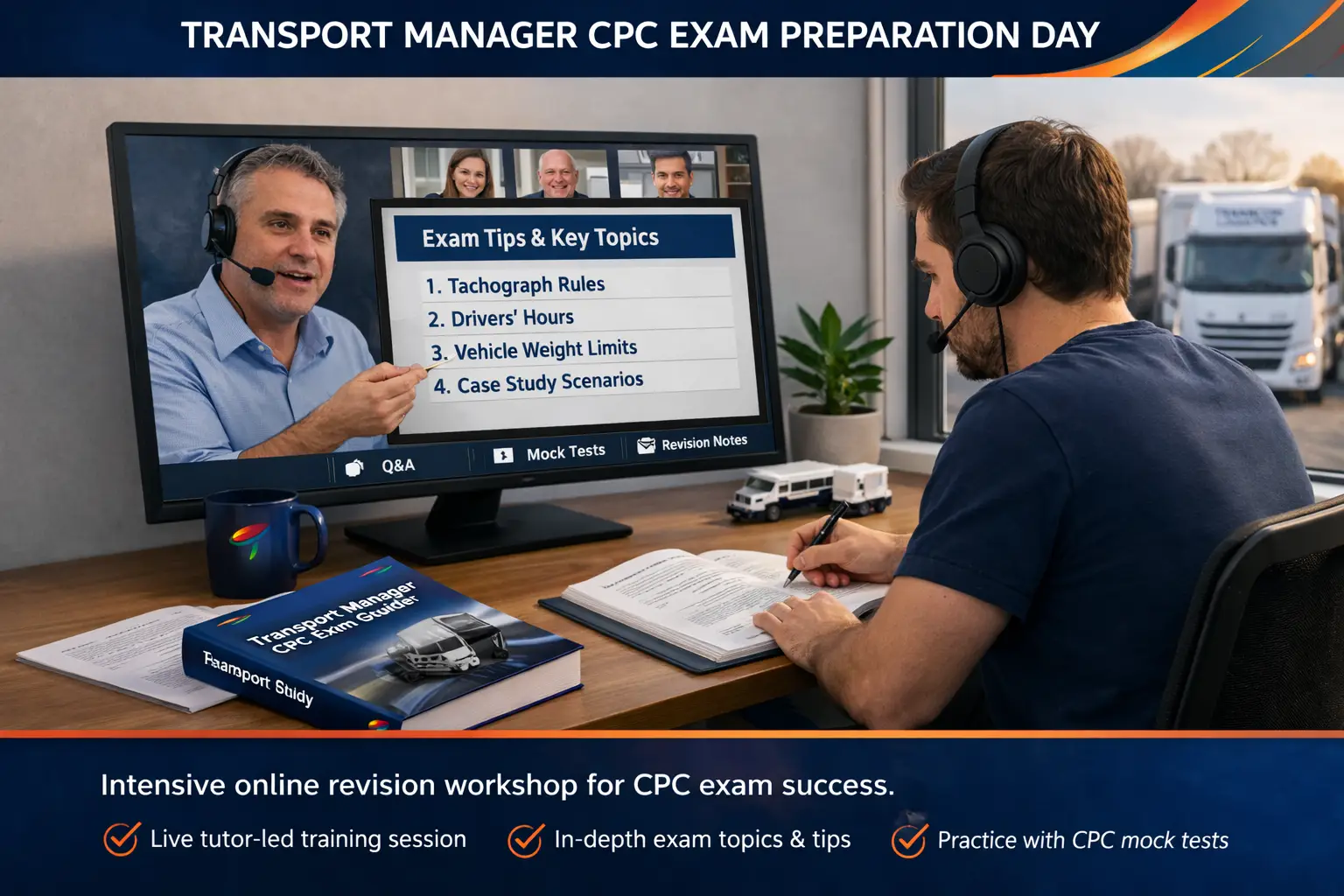
Our Transport Manager CPC Case Study Revision Day is a live, trainer-led session built entirely around this paper — timed mock questions, examiner marking insight and answer-structuring practice. It runs every Thursday, the day before the Friday case study exam, so you go in fresh.
See the Case Study Revision Day — £94.99The case study can draw on any part of the syllabus, but road haulage scenarios lean heavily on a familiar set of areas. Make sure you're comfortable applying, not just reciting:
Reading notes is not the same as practising the paper. The candidates who pass comfortably have done timed case study questions under pressure and had their answers marked, so they know where they're dropping marks before the real thing. Work through past and mock case studies to a clock, mark them honestly against the criteria above, and get feedback on the answers you were unsure about.
If you'd rather not do that alone, a focused revision day with a trainer who marks these papers is the fastest way to find and fix the gaps.
Already studied and just need to sharpen up for the case study? Take the Case Study Revision Day (£94.99). Starting from scratch and want the complete route to qualifying? Our 5-Day Transport Manager CPC (Road Haulage) course teaches the full syllabus, includes both exam sittings — and includes the Case Study Revision Day free.
The Skills and Education Group Awards road haulage case study assessment lasts 2 hours 15 minutes. It is based on one scenario, is worth 60 marks and contains a series of written questions with differing mark allocations.
Skills and Education Group Awards does not state a fixed number of case-study questions in its current assessment summary. The current specification does not prescribe a fixed question count, so candidates should treat it as a 60-mark paper and plan their time according to the marks shown.
Yes. Candidates may use a calculator, a dictionary and notes or books of their choice during the case study assessment.
The case study is worth 60 marks and the Skills and Education Group Awards specification gives a notional pass mark of 30. The separate multiple-choice assessment contains 60 questions and has a pass mark of 42.
Usually not for lack of knowledge, but for running out of time, not answering the exact question, not showing calculation working, leaving blanks, and failing to link answers back to operator licence compliance. For a fuller picture of the difficulty and pass rates, read our guide to how hard the Transport Manager CPC exam really is.
No. The two papers are assessed independently, so if you pass the multiple-choice paper but not the case study, you only re-sit the case study.
A revision day assumes you've already studied the syllabus and sharpens your exam technique for the case study. If you're starting from scratch, the full 5-day course teaches everything from the ground up and includes the Case Study Revision Day free.
Everyone learns differently. Whichever route you choose, they all lead to the same goods-vehicle qualification with the exams included:
The complete tutor-led route — full syllabus, both exam sittings, and the Case Study Revision Day included free.
View the 5-Day course →A one-day live revision workshop focused entirely on passing the case study. £94.99, or free with the 5-day course.
Book the Revision Day →Study the full syllabus at your own pace, in your own time, with materials and exams included.
Explore home study →Always check the current requirements with the official bodies: