

Tachograph Compliance: Protect Your Licence
Strengthen tachograph compliance through clear checks, accurate records and accountable management that protects your operator licence on every journey.
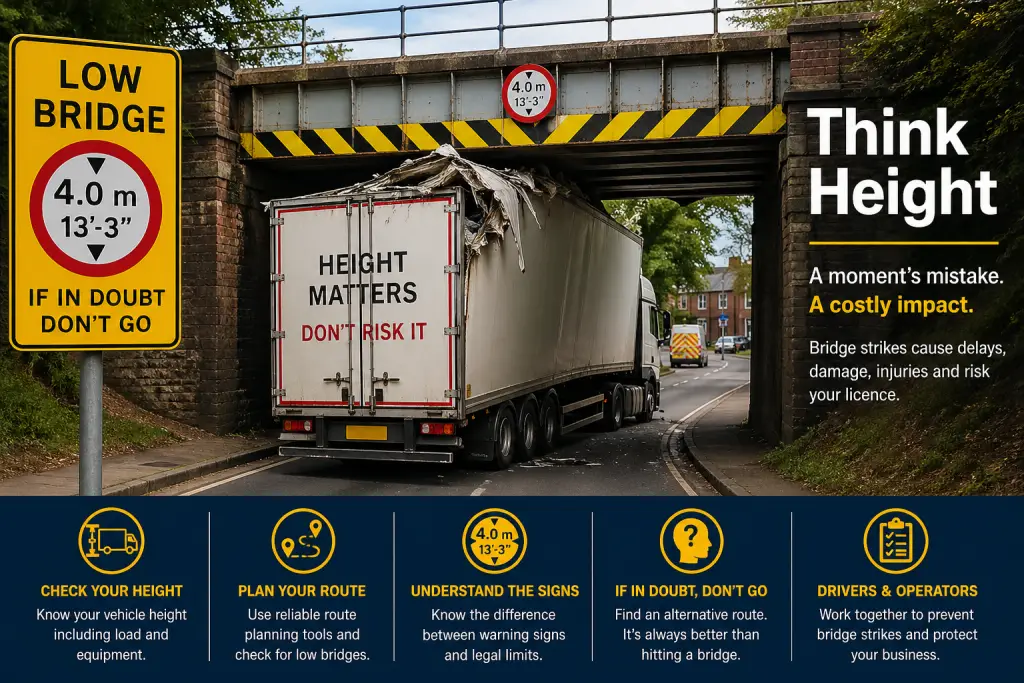
No professional driver starts the day expecting to hit a bridge. Most bridge strikes are not caused by someone deliberately taking a reckless chance. They happen because a system has failed somewhere: the vehicle height was not checked, the route was not planned properly, the load height changed, the in-cab height display was wrong, or the driver was diverted and left to make a decision under pressure.
That is why bridge strike prevention should not be treated as a quick reminder on a noticeboard. It needs to be part of daily walkaround checks, route planning, driver training, transport manager oversight and operator licence compliance.
Quickly convert vehicle height between feet/inches and metres before checking low bridge restrictions. This is useful for drivers, planners, transport managers and operators checking in-cab height displays, route information and journey paperwork.
Important: this calculator converts measurements only. It does not replace physically measuring the actual vehicle, trailer, load and equipment at the highest point before the journey.
bridge strikes were reported across the Network Rail network between 1 April 2024 and 31 March 2025.
Network Rail says, on an average day, at least five HGV or bus drivers put themselves and others at risk through bridge strikes.
Vehicles over 3 metres high must display an in-cab overall height indicator. The height should reflect the vehicle, trailer, load and equipment in travelling condition.
A bridge strike is not just a vehicle damage issue. It can injure the driver, passengers, road users, railway staff and people travelling by train. It can also close roads, delay rail services, damage infrastructure and trigger investigation by enforcement bodies.
The Senior Traffic Commissioner has warned operators that large vehicles must be operated without unacceptable risks to road safety. That includes the risk of bridge strikes. Operators are expected to assess risk, plan routes, train drivers, train transport managers and planners, provide height information, use height measurement gauges where appropriate, and keep established running heights available for vehicles and trailers.
For operator licence holders, this matters. Poor systems, weak training, missing records or repeated failures can point towards wider management problems. In serious cases, regulatory action by the Traffic Commissioner can affect the operator’s licence and the business behind it. This is why bridge strike controls should form part of wider Operator Licence Awareness Training, transport manager oversight and routine compliance review.
It is easy to look at a bridge strike photo and judge the driver. In reality, most drivers involved in a bridge strike did not think they were going to hit the bridge until the moment it happened.
That does not remove responsibility. It does explain why operators need a system that works before the driver gets near the bridge. A driver under time pressure, following a diversion, using the wrong sat nav, or relying on an old height figure can make a very expensive mistake in seconds.
Good bridge strike prevention gives drivers the correct information, the confidence to stop, and a clear procedure to follow when something does not look right.
There is not one simple “bridge strike fine” that applies to every case. The consequences depend on the facts: the driver’s conduct, the operator’s systems, the road signs, the vehicle height, the load, the route planning, the damage caused, and whether people were put at risk.
| Risk area | Possible consequence | Why it matters |
|---|---|---|
| Driver conduct | Penalty points, fines, prosecution, vocational driver conduct action, suspension or disqualification in serious cases. | A bridge strike can suggest that the driver did not know the vehicle height, ignored signs, failed to plan, or continued when they should have stopped. |
| Operator licence | Public Inquiry, warning, curtailment, suspension or revocation of the operator licence depending on seriousness and history. | The Traffic Commissioner may look beyond the individual driver and consider whether the operator had effective control measures in place. |
| Financial recovery | Claims for bridge inspection, repair, railway delay compensation, vehicle recovery, vehicle damage and business interruption. | Bridge strikes can be expensive even where there is no injury. The cost is not limited to damage to the vehicle. |
| Insurance and reputation | Increased premiums, excesses, loss of customer confidence and negative press coverage. | A preventable bridge strike can damage trust in the operator’s management systems. |
Prevention is usually far cheaper than reacting after an incident. A simple height check, a proper route plan and a driver who is allowed to stop and ask for help can protect the driver, the licence and the business.
Network Rail publishes named bridge strike hotspots to help raise awareness of repeated incidents. The table below shows the most struck Network Rail bridges for 2024/25.
| Rank | Location | Network Rail route code | Reported strikes 2024/25 |
|---|---|---|---|
| 1 | Watling Street, A5 single span, Hinckley | WCS | 22 |
| 2 | Harlaxton Road, Grantham | EC | 18 |
| 3 | Stuntney Road, Ely | ANG | 15 |
| 4 | Stonea Road | ANG | 15 |
| 5 | Lower Downs Road, Wimbledon | WEX | 15 |
| 6 | Station B4105, Berkswell | CEN | 14 |
| 7 | Ickleton Road, Great Chesterford | ANG | 11 |
| 8 | Barrowby Road, Grantham | EC | 11 |
| 9 | Abbey Farm, Thetford | ANG | 11 |
| 10 | Coddenham Road, Needham Market | ANG | 11 |
Hotspot data should not be treated as a list of the only bridges that matter. A low bridge on an unfamiliar diversion can be just as dangerous as a nationally known hotspot. The point is simple: some bridges are hit again and again, which proves that signs alone do not prevent every incident.
Low bridge signs are not all the same. Drivers must understand the difference between a warning sign and a regulatory prohibition sign.
| Sign type | What it means | Driver action |
|---|---|---|
| Red circular height restriction sign | This is a regulatory prohibition. At non-arch bridges, it is unlawful for an overheight vehicle to pass the sign. | Do not proceed if the vehicle, trailer, load or equipment exceeds the height shown. |
| Triangular low bridge warning sign | This warns of maximum headroom, commonly used where the available height varies, such as at arch bridges. | Slow down, assess the route, follow road markings and do not continue if the vehicle may not clear the bridge. |
| Advance warning sign | This warns of a height restriction ahead and may show a side road or alternative route. | Use the warning early. Do not wait until the vehicle is trapped at the bridge. |
| Variable message sign with flashing amber lights | Some high-risk bridges use equipment that detects overheight vehicles and activates warning lights. | Stop safely and do not ignore the warning. Contact the transport office if unsure. |
Bridge strike prevention should sit inside the operator’s normal compliance system. It should not depend on one experienced driver “knowing the route” or a planner assuming the vehicle will be fine.
These controls can also be tested during an operator licence compliance audit, especially where the business runs high vehicles, plant, waste, car transporters, double-deck trailers or variable-height loads.
The safest time to prevent a bridge strike is before the vehicle leaves the yard, depot or customer site. The driver should know the actual travelling height of the vehicle, including trailer, load and any equipment.
The driver should measure the highest point of the vehicle or its load. For vehicles carrying plant, cars, waste, containers, access equipment or uneven loads, the highest point may change from one journey to the next.
Cranes, grabs, air deflectors, tail lifts, beacons and other equipment can affect overall height. If equipment can move or be raised, the driver and operator need a clear procedure to confirm its safe travelling position.
Where relevant, the travelling height should be recorded as part of the walkaround check or route planning record. A record gives the operator evidence that the check was done, not just assumed.
The in-cab display must show the correct maximum travelling height. If the display is missing, damaged, unreadable or wrong, that should be treated as a defect and reported through the operator’s normal defect system.
If the vehicle is loaded, unloaded, reloaded, coupled to a different trailer or fitted with different equipment, the height may change. The driver should not rely on a previous journey’s height if the vehicle combination or load has changed.
Route planning should consider the height, width and weight of the vehicle and load. A standard car sat nav is not designed to protect an HGV, bus or coach from low bridges. Operators should use suitable planning tools and make sure drivers understand the planned route.
| Risk | What can go wrong | Control measure |
|---|---|---|
| Wrong navigation system | The driver follows a route suitable for cars but not for the vehicle height. | Use HGV, PSV or commercial vehicle route planning tools and keep vehicle dimensions updated. |
| Vehicle height not known | The driver approaches a low bridge without knowing whether the vehicle will clear it. | Measure, record and display the correct travelling height before the journey. |
| Unexpected diversion | The driver leaves the planned route and encounters a low bridge under pressure. | Tell drivers to stop safely and contact the transport office before continuing on an unknown route. |
| Arched bridge | The height clearance may only apply within the marked centre section, not close to the kerb. | Train drivers on bridge signage, road markings and the need to stop if unsure. |
| Variable load height | The same vehicle may be safe one day and over-height the next. | Re-measure after loading, unloading, coupling changes or equipment changes. |
Abnormal loads and STGO movements need extra care because the risk is not only height. Weight, width, axle loading, rigid length, route suitability and bridge structure limits can all matter.
An abnormal load may include a vehicle or load over 44,000kg, an axle load over specified limits, a width over 2.9 metres, or a rigid length over 18.65 metres. For these movements, operators may need to notify highway, police and bridge authorities and use the ESDAL system to plan routes, check suitability, submit notifications and identify potential route problems.
A driver should never be encouraged to “try it and see”. If there is any doubt about bridge clearance, the correct decision is to stop safely before reaching the bridge and get help.
If a bridge strike happens, it must be treated as a serious incident. The priority is safety, reporting and preventing further risk to road and rail users.
Operators can use the following wording as a starting point for an internal bridge strike prevention procedure. It should be adapted to match your fleet, operating centres, routes and vehicle types.
Bridge Strike Prevention Policy — Sample Wording
Drivers must know the overall travelling height of their vehicle, trailer, load and equipment before starting any journey. Where the vehicle is over 3 metres high, the correct overall height must be displayed in the cab where the driver can see it.
Drivers must measure or confirm the travelling height whenever the load, trailer, vehicle combination or equipment position changes. Vehicle height must be recorded as part of the walkaround check or journey record where applicable.
Routes must be planned to avoid low bridges and unsuitable restrictions. Drivers must not rely solely on car navigation systems. If a driver is diverted or becomes unsure whether the vehicle can safely pass under a bridge, they must stop in a safe place and contact the transport office for guidance.
Any bridge strike, suspected bridge strike or near miss must be reported immediately and investigated by the operator. Corrective action may include driver retraining, route review, defect rectification, disciplinary action where appropriate, and changes to planning procedures.
A short toolbox talk can help prove that bridge strike prevention is being actively managed. It should be practical, recorded and repeated, especially for drivers using high vehicles, variable loads or unfamiliar routes.
Bridge strike prevention is not only a driver awareness topic. It also links directly to operator control, route planning, training records, defect reporting, transport manager oversight and the ability to show that the business is managing road safety risk.
For drivers, the subject fits naturally into Driver CPC training because it deals with safe operation, route planning, vehicle checks, hazard awareness and professional decision-making. Transcom National Training covers this risk through our dedicated Accident Awareness, Bridge Strikes and VRUs Driver CPC course.
For operators, directors and transport managers, bridge strike prevention should also be discussed through Operator Licence Awareness Training, Transport Manager CPC Refresher training and operator licence compliance audits. If a bridge strike exposes weak systems, the issue may move beyond one driver and become a wider operator licence concern.
A bridge strike happens when a vehicle, trailer, load or equipment collides with a bridge. It can damage road or rail infrastructure, endanger people and cause major disruption.
Drivers must know the vehicle height and follow the planned route, but operators also need suitable systems for route planning, driver training, height measurement, in-cab height displays and incident reporting.
Yes. Vehicles over 3 metres high must display an in-cab overall height indicator. The displayed height should reflect the vehicle, trailer, load and equipment in its travelling condition.
The driver should stop in a safe place before the bridge, avoid guessing, and contact the transport office, transport manager or supervisor for guidance. If the vehicle blocks the highway or creates immediate danger, the police should be contacted.
Yes. A bridge strike may raise questions about operator control, route planning, driver training and compliance systems. In serious cases, the Traffic Commissioner may consider regulatory action.
A red circular height restriction sign is a regulatory prohibition and overheight vehicles must not pass it. A triangular low bridge sign is a warning, often used where the available headroom varies, such as at an arch bridge.
They can be. Abnormal loads may involve extra height, width, weight, length or axle loading issues, so route planning, authority notification and structure checks are especially important.
This guide has been written using official and recognised industry sources, including:
This article is for general training and compliance awareness only. Operators should always check current legislation, official guidance and their own transport operation before making compliance decisions.
Transcom National Training supports UK operators with practical driver training, transport manager development and operator licence compliance support, including Driver CPC training, Operator Licence Awareness Training, Transport Manager CPC Refresher training and compliance audits.
If you operate HGVs, buses, coaches, plant transporters, car transporters, high-load vehicles or restricted operator licence vehicles, bridge strike prevention should be part of your practical compliance system — not just a poster on the wall.
Strengthen tachograph compliance through clear checks, accurate records and accountable management that protects your operator licence on every journey.

Compare a standard versus restricted licence for UK goods operators: scope, transport manager rules and the compliance duties that protect your licence.

Build a CPC exam revision timetable that turns the Transport Manager syllabus into confident, structured preparation for examination day with purpose.

Operator licensing is not a formality. See how licence type, undertakings, transport management and evidence help protect a lawful UK fleet every day.

Transport compliance protects more than paperwork. Build evidence, control risk and meet operator licence duties with practical, accountable systems daily.

A practical guide to transport manager appointment: eligibility, operator licence steps, legal duties and evidence needed for compliant daily operations.
|
Uploaded
Failed
|
 |