Applying for an Operator Licence? Why Experienced Support Can Save Weeks of Delay
Applying for an operator licence can look straightforward. You complete the VOL portal, upload the evidence, publish the notice and wait for the licence to be granted.
In practice, small mistakes can cause big delays. A missing document, unclear financial evidence, incorrect public notice, weak maintenance arrangements or an operating centre issue can slow the application down before the business has even started operating.
An operator licence application is not just an online form. It is the first point where your business shows that it can meet the responsibilities attached to running commercial vehicles legally and safely.
At Transcom National Training, we provide Operator Licence Application Assistance for Restricted, Standard National and Standard International applicants across the UK.
Operator licence applications are not just form-filling
The Traffic Commissioner needs to be satisfied that the application is accurate, complete and properly evidenced. That means the details in the VOL portal, the supporting documents, the public notice, the maintenance arrangements and the operating centre information all need to line up.
If something is unclear, inconsistent or missing, the application can be delayed while further information is requested. For a business waiting to start work, add vehicles or meet customer commitments, that delay can quickly become expensive.
Three things to check before you apply
- Finance: Is your financial evidence recent, clear and sufficient for the number of vehicles and trailers you are applying for?
- Public notice: Is the notice placed in a newspaper that properly covers the operating centre area, with the wording, address and dates checked carefully?
- Maintenance: Are the inspection intervals, maintenance provider details and written arrangements clear, realistic and signed where required?
How long does an operator licence application take?
GOV.UK advises that you will usually get a decision within 7 weeks, but it can take longer if the right supporting documents are not provided when you apply. The official goods vehicle operator licensing guide also advises applicants to apply at least 9 weeks before the date the licence is needed.
If you want the full process broken down before you submit, read our step-by-step guide to applying for an operator licence.
If your application is delayed because of missing evidence or a simple oversight, you may not just lose a few days. You could lose weeks. If vehicles, contracts, drivers or customers are waiting, that delay can put pressure on the whole business.
Why is my O Licence application delayed?
One of the most common questions applicants ask is: why is my O Licence application delayed? The answer is often practical rather than dramatic.
- financial evidence does not clearly show the required funds;
- the public notice has been placed incorrectly or contains errors;
- the operating centre information is incomplete or unclear;
- maintenance arrangements are not properly evidenced;
- supporting documents are missing, inconsistent or out of date;
- the legal entity applying for the licence does not match the documents provided.
These issues can often be avoided with a proper pre-submission check from an experienced transport compliance team.
One clear fixed price for operator licence application help
Professional support without confusing tiered pricing
Some providers charge different prices depending on whether the application is for a Restricted, Standard National or Standard International operator licence. At Transcom, we take a simpler approach.
The application phase still needs careful review, whichever licence type you are applying for. The evidence has to be checked, the details need to be consistent, and the application should be prepared properly before it is submitted.
Our fixed fee gives applicants a clear price for professional, compliance-led support without hidden application support charges.
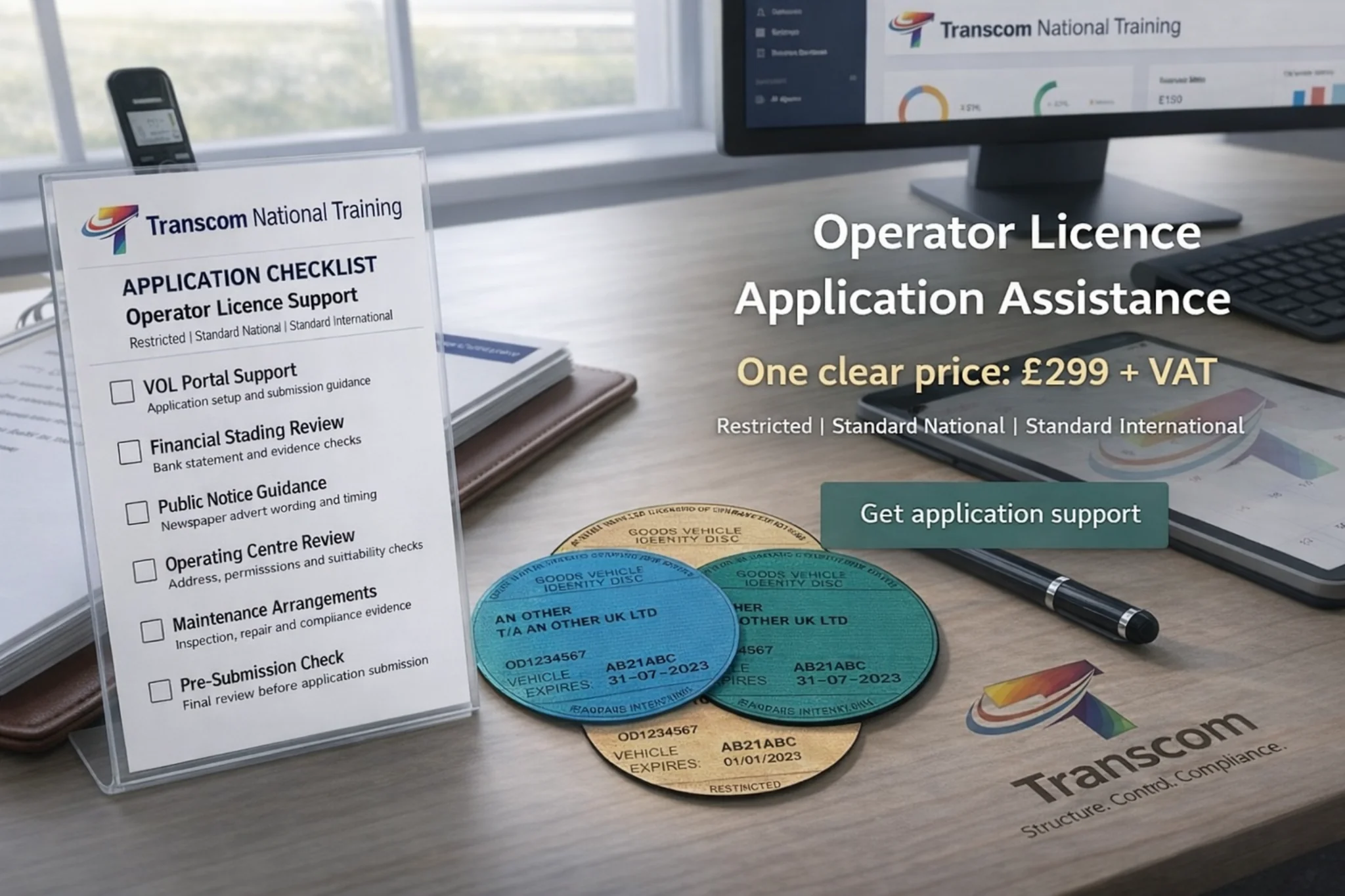
Operator Licence Application Assistance
Applies to Restricted, Standard National and Standard International operator licence applications nationwide.
Restricted operator licence support for construction, scaffolding and plant hire
Many restricted licence applicants are not haulage companies. They are builders, scaffolders, construction companies, plant hire firms, groundworks businesses and other operators who need to move their own goods, equipment or materials.
The risk is that restricted licence applicants sometimes underestimate the responsibility that comes with the licence. A restricted licence still carries serious duties around vehicle maintenance, defect reporting, driver control, roadworthiness, record keeping and operating centre management.
When application support is especially useful
Application support can be particularly useful where the business is applying for the first time, has limited transport compliance experience, needs a restricted operator licence, or cannot afford avoidable delays.
- new restricted operator licence applications;
- construction, scaffolding, plant hire and groundworks operators;
- businesses adding vehicles to support new contracts;
- applicants unsure about public notice wording or placement;
- operators unsure whether their maintenance evidence is strong enough;
- businesses that need the application checked before submission.
If your systems are already in place but you want to test whether they would stand up to scrutiny, our Operator Licence Compliance Health Check and Audit may also be useful.
Can you guarantee my operator licence will be granted?
No. No responsible provider should guarantee that an operator licence will be granted. The final decision always sits with the Traffic Commissioner.
What we can do is help you prepare properly, reduce avoidable mistakes, check that key evidence has been considered, and make sure the application is treated seriously from the start.
Need help applying for an operator licence?
Get your application checked by an experienced transport compliance team before a simple oversight turns into a costly delay.