

Who Needs a Transport Manager in the UK?
Who needs a transport manager? Learn when UK operator licence rules require professional competence, a named TM and practical control of fleet compliance.
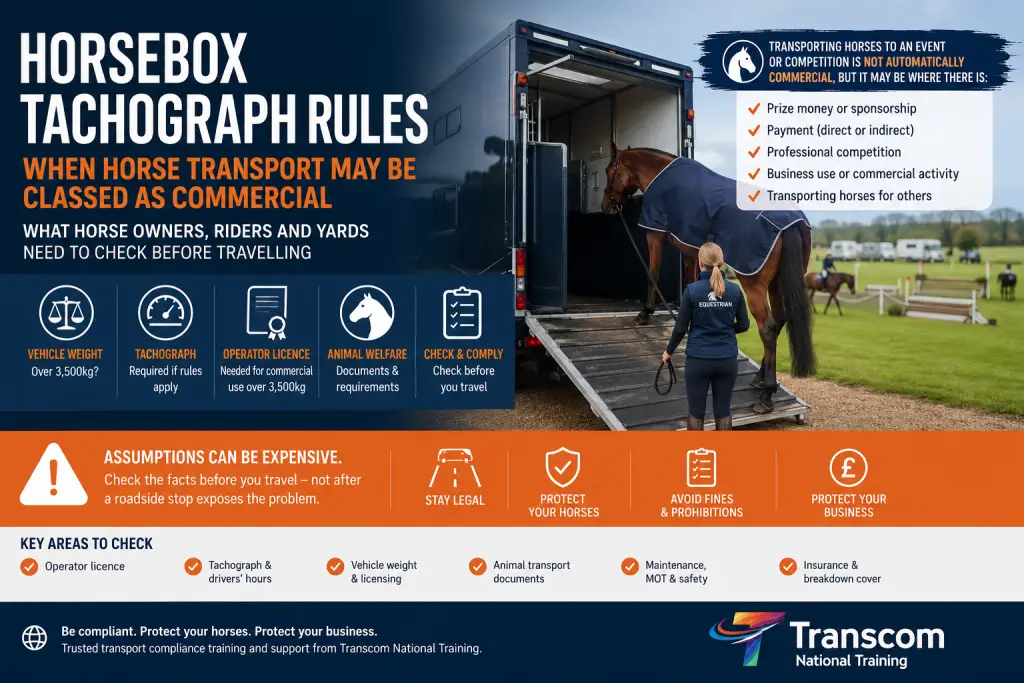
Horsebox enforcement and tachograph rules are a common source of confusion for horse owners, riders, yards and equestrian businesses. This guide explains what to check before travelling.
Transporting horses can look like a simple private journey, but the rules can change quickly once vehicle weight, prize money, sponsorship, business use, paid transport, horses belonging to other people, drivers’ hours and animal welfare requirements are involved.
The key point is simple: taking a horse to an event, show or competition is not automatically commercial, but it may be regarded as commercial where there is payment, prize money, sponsorship, business use, professional activity or any direct or indirect reward.
Horse transport may become commercial where the journey is connected to a business, payment, reward, sponsorship, prize money, professional competition, breeding, dealing, livery, transport for other people, or another service that includes transport.
GOV.UK states that commercial purposes can include being paid directly or indirectly to transport horses, getting payment as a result of transporting horses, such as prize money from competitions, and using horseboxes for a business. Source: GOV.UK horsebox and trailer guidance.
That does not mean every amateur competitor needs an operator licence or tachograph. It means horsebox owners should not assume they are exempt without checking the actual facts.
Commercial horsebox or trailer combinations over 3,500kg may need an operator licence.
The non-commercial carriage exemption for leisure carriage only applies up to 7.5 tonnes.
Commercial animal transport over 65km may require authorisation and competence documents.
International hire and reward journeys into Europe need extra operator licence and Smart 2 tachograph checks.
This guide is written for horsebox owners, riders, yards, professional competitors, breeders, dealers and equestrian businesses that want a clear compliance overview before travelling.
A private owner transporting their own horse for a genuine hobby or leisure activity may be treated differently, especially where there is no direct or indirect income, no business link and no professional or commercial activity.
A yard, professional rider, breeder, dealer, transporter, sponsored competitor or business using a horsebox may need to consider operator licensing, tachographs, drivers’ hours, records, maintenance systems and animal transport documents.
Horsebox compliance causes confusion because it sits between equestrian activity and commercial vehicle law. A journey may feel like sport or leisure, but enforcement officers may look at the wider facts.
```At the roadside, the questions may include:
A valid MOT or annual test is not the whole answer. A horsebox can be taxed, insured and tested, but still be non-compliant if the wrong licence, tachograph, operator licence, maintenance or animal welfare requirements apply.
```Not automatically. A genuine amateur taking their own horse to an event as a hobby is not the same as a professional rider, sponsored competitor, yard, breeder, dealer or transporter moving horses as part of a business.
```However, the position may change where the journey is linked to:
GOV.UK specifically includes prize money from competitions as an example of payment arising from transporting horses. That is why eventing, showing and competition journeys should not be dismissed automatically as private leisure use.
If the journey has a commercial link, the vehicle is over the relevant weight threshold, or horses are being transported for someone else, do not guess. Check the operator licence, tachograph, drivers’ hours, animal welfare and document position before travelling.
If you are trying to decide whether a horsebox journey is private or commercial, ask:
```The more the journey looks connected to income, reward, business activity or transport for others, the more carefully the rules need to be checked.
```GOV.UK states that you will usually need a goods vehicle operator licence if you use a horsebox or horse trailer for commercial purposes with a combined gross plated weight over:
```GOV.UK also states that an operator licence is needed even if the vehicle is only used for commercial purposes for a short period, such as one day or more. Source: GOV.UK operator licence guidance for horseboxes.
Commercial purposes may include being paid directly or indirectly to transport horses, receiving payment as a result of transporting horses, receiving prize money from competitions, or using horseboxes for a business.
Being paid indirectly can include a membership subscription to a club or paying for another service that includes transport of the horses.
The type of operator licence depends on the vehicle, where it is used and who owns the horses being transported.
| Situation | Likely operator licence issue | Why it matters |
|---|---|---|
| Horsebox or vehicle and trailer combination over 3,500kg, used commercially, carrying your own horses | Restricted operator licence may be required | A restricted licence is for operators carrying their own goods, which can include their own horses in a commercial setting. |
| Horsebox or combination over 3,500kg, used commercially, carrying horses you do not own within the UK | Standard national operator licence may be required | Transporting other people’s horses can move the operation beyond own-account restricted licence use. |
| Horsebox or combination over 3,500kg, used commercially, carrying horses you do not own outside the UK | Standard international operator licence may be required | International transport creates a higher compliance requirement. |
| Private leisure journey with no commercial purpose | Operator licence may not be required | GOV.UK says you do not need an operator licence if you are only transporting horses or goods for non-commercial purposes, such as leisure activities. |
DVSA can carry out roadside checks and GOV.UK warns that a vehicle can be impounded if the correct operator licence is not held.
```Tachograph rules are one of the most misunderstood areas of horsebox compliance. The mistake is assuming that a horsebox is automatically outside the rules because it is carrying horses. That is not safe.
```GOV.UK’s tachograph guidance says tachographs record driving time, speed and distance and are used to make sure drivers and employers follow drivers’ hours rules. A tachograph must be used where the vehicle comes under assimilated drivers’ hours rules or AETR rules. Source: GOV.UK tachograph rules.
GOV.UK’s horsebox guidance states that drivers’ hours rules must be followed if you use a vehicle that weighs more than 3,500kg or use the vehicle for commercial purposes. It also states that you must use a tachograph if the vehicle you are driving weighs more than 3,500kg.
The detailed GOV.UK goods vehicle drivers’ hours guidance gives an exemption for vehicles or combinations of vehicles with a maximum permissible mass not exceeding 7.5 tonnes used for the non-commercial carriage of goods. GOV.UK gives horses as an example of goods transported as part of a leisure pursuit. Source: GOV.UK drivers’ hours exemptions.
| Horsebox or combination | Journey type | Practical tachograph risk |
|---|---|---|
| 3,500kg or less | Private or commercial | Assimilated tachograph rules normally focus on vehicles over 3,500kg. If used commercially, GB domestic drivers’ hours may still need checking. |
| Over 3,500kg but not exceeding 7.5 tonnes | Genuinely non-commercial leisure use | The non-commercial carriage exemption may apply, but only where there is no hire or reward, no direct or indirect income, and no professional or commercial link. |
| Over 3,500kg but not exceeding 7.5 tonnes | Commercial, business-linked, professional, sponsored, paid or reward-linked use | Do not rely on the leisure exemption. Tachograph and assimilated drivers’ hours requirements may apply. |
| Over 7.5 tonnes | Private or commercial | The specific non-commercial exemption for leisure carriage only applies up to 7.5 tonnes. Seek proper advice before assuming any exemption applies. |
GOV.UK defines non-commercial carriage as carriage by road where no direct or indirect remuneration is received, where no direct or indirect income is generated for the driver or others, and where the carriage is not linked to professional or commercial activity.
That definition is important. A horsebox journey may stop looking private if there is payment, sponsorship, professional competition, business use or another income link.
```Horsebox owners, professional riders, yards and equestrian businesses travelling into Europe should check whether Smart 2 tachograph and international operator licensing rules apply to their journey.
GOV.UK states that from 1 July 2026, a full Smart 2 tachograph must be fitted into goods vehicles over 2.5 tonnes used for international journeys for hire and reward.
This is especially relevant where horses are transported to Europe for shows, sales, breeding, professional competition, commercial transport, sponsored activity, or transport connected with a business.
The rule should not be overstated. GOV.UK also states that if the international journey is for the driver or company’s own account and driving is not the driver’s main activity, there is no requirement to fit a tachograph. Goods vehicles over 2.5 tonnes but under 3.5 tonnes that are used only in the UK do not need a tachograph fitted under this rule.
European tachograph compliance is not only a large HGV horsebox issue for international commercial journeys. Some lighter vehicles and combinations used for international hire or reward work may also need checking.
Higher-risk examples include:
There is also a separate operator licensing issue. GOV.UK guidance says a standard international goods vehicle operator licence is needed to transport goods for hire or reward in the EU, Iceland, Liechtenstein, Norway and Switzerland when using vans, vans towing trailers or cars towing trailers. For vehicle combinations, the rule can apply where the maximum laden weight is over 2.5 tonnes and up to 3.5 tonnes.
The safest position is simple: if you travel to Europe with horses and there is any payment, reward, sponsorship, professional or business link, check the operator licence, tachograph, drivers’ hours and animal transport position before travelling.
Source: GOV.UK tachograph rules for goods vehicles and GOV.UK guidance on transporting goods in Europe using vans or car and trailers.
```Prize money and sponsorship are the grey areas that create the most confusion.
```GOV.UK gives prize money from competitions as an example of payment arising from transporting horses. That is the safest official starting point.
An older VOSA-era horsebox guide also explained the practical distinction between modest incidental prize money in an amateur hobby and activity that goes beyond a hobby, such as significant sponsorship, professional status or activity designed to make a profit or be cost neutral. Because that PDF is older and hosted by a third party, it should be treated as useful background rather than the main legal authority. The current GOV.UK guidance should take priority. Background source: VOSA-era horsebox advice PDF.
The more the journey is connected to income, business, customers, sponsorship, professional activity or reward, the harder it becomes to argue that it is simply private leisure transport.
You must hold the correct driving licence category for the size and type of vehicle you are driving or towing. GOV.UK states that a horsebox will usually count as a medium or large vehicle.
```If a horsebox has a maximum authorised mass over 3,500kg, an HGV licence is required. GOV.UK also explains that Driver Certificate of Professional Competence requirements depend on whether driving is the main part of the job and whether any exemption applies. Source: GOV.UK driving licence category guidance.
If you are towing a trailer, you must also check your towing entitlement. GOV.UK explains that car and trailer entitlement depends on when you passed your driving test and the weight of the vehicle and trailer combination.
The British Horse Society also warns that driving a horsebox or towing a trailer is very different from driving a car because of the extra weight, vehicle size and the welfare of the horse on board. BHS strongly recommends towing training for those new to towing or returning after a long break. Source: British Horse Society transporting your horse guidance.
```Horse transport is not only a vehicle compliance issue. Animal welfare transport rules may also apply, especially where horses are transported in connection with an economic activity.
```GOV.UK says that anyone transporting animals in Great Britain should check whether they need a transporter authorisation, certificate of competence, certificate of vehicle approval, animal transport certificate or navigation system. Source: GOV.UK transporting animals in Great Britain.
GOV.UK states that a UK-issued transporter authorisation is required if animals are transported over 65km by air, road, rail or sea. Type 1 authorisation applies for journeys over 65km and up to 8 hours. Type 2 authorisation applies for journeys over 8 hours.
GOV.UK also states that a certificate of competence is required if animals are transported over 65km by road and the animals include horses or other equines. Where an attendant travels with the animals, that attendant must also have a certificate of competence.
For journeys longer than 8 hours by road, GOV.UK states that a certificate of vehicle approval is required when transporting horses and other equines.
GOV.UK also states that an animal transport certificate is a written record confirming the animals’ origin and ownership, place of departure, date and time of departure, intended destination and expected journey duration. A copy must be carried and made available on request, and a copy must be kept for at least 6 months from the date the journey ends.
GOV.UK animal welfare guidance states that animals must not be transported in a way likely to cause injury or unnecessary suffering. It also says that if horses are being transported, the vehicle must be cleaned before loading and disinfected where necessary. Source: GOV.UK animal welfare in transport.
```GOV.UK says horseboxes need an MOT every year, with the type of MOT depending on the vehicle weight. A horsebox weighing more than 3,500kg falls into HGV testing arrangements.
```GOV.UK also says horsebox owners should have the vehicle checked and serviced by a qualified mechanic, carry out safety checks of components likely to become defective, and inspect the horsebox floor including under matting or plates.
For horseboxes over 3,500kg, GOV.UK points owners towards HGV daily walkaround checks. For horseboxes of 3,500kg or less, van daily walkaround checks are referenced. Internal stalls, partitions, breast bars and loading ramps also need checking.
For trailers, GOV.UK says trailer safety checks should be carried out every time a horse trailer is towed. Internal stalls, partitions, breast bars, loading ramps, floors and under-matting areas should also be checked.
A roadside examiner may still look at brakes, tyres, lights, body condition, floors, ramps, partitions, tachograph use, documents, weight, load security and whether the vehicle is being operated under the correct legal framework.
The documents required depend on the journey, the vehicle, the horse, the destination and whether the transport is private or commercial.
```Before travelling, check whether you need:
The British Horse Society states that by law, the horse passport must accompany the horse at all times, including when travelling locally, nationally or internationally for any purpose. The passport should be accessible in the vehicle during travel.
```Hiring a transporter does not remove the need to check compliance. BHS advises horse owners to ask about the transporter’s experience, training, credentials and vehicle safety checks.
```Where animal welfare transport rules apply, GOV.UK says that if you contract or subcontract someone to transport animals, you must make sure they hold a transporter authorisation for the species being transported. An authorised transporter should make their documents available to view.
For journeys over 8 hours, GOV.UK says you can check whether a transporter is on the list of Type 2 authorised transporters.
Assuming the journey is private because it is your horse. Assuming it is exempt because it is sport. Assuming prize money does not matter. Assuming a 7.5 tonne horsebox is always treated as private. Assuming a valid MOT means everything is compliant.
Those assumptions can be expensive. The safest approach is to check the facts before travelling, not after a roadside stop exposes the problem.
Use this checklist before travelling to a show, competition, event, clinic, sale, yard, veterinary appointment or customer premises.
```| Assumption | Why it can be wrong |
|---|---|
| “It is my own horse, so it is private.” | Ownership matters, but it is not the only factor. Business use, sponsorship, prize money or professional activity may still create a commercial link. |
| “It is only a show, so it cannot be commercial.” | Competitions may involve prize money, sponsorship, professional activity or business promotion. |
| “I only use the horsebox commercially for one day.” | GOV.UK says an operator licence can be required even if commercial use is only for a short period, such as one day or more. |
| “A 7.5 tonne horsebox is always exempt.” | The non-commercial exemption applies only where the use is genuinely non-commercial and the vehicle or combination does not exceed 7.5 tonnes. |
| “The MOT is valid, so everything is fine.” | Roadworthiness, tachograph use, drivers’ hours, operator licensing, documents, animal welfare and weight can all still be checked. |
| “I borrowed the horsebox, so it is not my issue.” | The driver and user still need to ensure the journey is lawful, the vehicle is being used correctly and required records or documents are available. |
| “My 4x4 and trailer are not an HGV, so European rules cannot affect me.” | International hire and reward journeys over 2.5 tonnes need specific checks. Some lighter combinations may be affected where the journey is commercial and cross-border. |
Transcom National Training provides practical transport compliance training and operator licence support for businesses that operate goods vehicles, including restricted operators, company directors, transport managers and compliance teams.
For equestrian businesses, yards, breeders, dealers and professional operators using heavier horseboxes, the safest route is to check the position before a roadside stop exposes the problem.
``` ```You may need a tachograph if the vehicle comes under assimilated or AETR drivers’ hours rules. Vehicles over 3,500kg need careful checking, especially where the use is commercial. A non-commercial exemption may apply to vehicles or combinations not exceeding 7.5 tonnes used genuinely for private leisure carriage, but it must not be assumed where there is payment, reward, sponsorship, business use or professional activity.
Not automatically. A genuine amateur leisure journey may be non-commercial. However, GOV.UK includes prize money from competitions as an example of payment arising from transporting horses, so shows, events and competitions should be checked carefully where there is prize money, sponsorship, professional activity or business use.
It can be a factor. GOV.UK states that commercial purposes can include getting payment as a result of transporting horses, including prize money from competitions. The whole context matters, including whether the activity is amateur, professional, business-linked, sponsored or intended to generate income.
You will usually need a goods vehicle operator licence if you use a horsebox or horse trailer for commercial purposes with a combined gross plated weight over 3,500kg in the UK or internationally, or over 2,500kg in Europe. Non-commercial leisure transport may not require an operator licence.
A restricted licence may apply where you transport your own horses commercially in a vehicle or combination over 3,500kg. A standard national or standard international licence may be required where horses belonging to other people are transported, depending on where the transport takes place.
From 1 July 2026, GOV.UK says a full Smart 2 tachograph must be fitted into goods vehicles over 2.5 tonnes used for international journeys for hire and reward. This may affect some lighter vehicles and combinations used for commercial horse transport into Europe. The rule does not apply to vehicles over 2.5 tonnes but under 3.5 tonnes used only in the UK, and GOV.UK also identifies an own-account exception where the journey is for the driver or company’s own account and driving is not the driver’s main activity.
Yes. Animal welfare rules apply when transporting horses. Where horses are transported in connection with an economic activity, additional requirements may include transporter authorisation, certificate of competence, certificate of vehicle approval, animal transport certificate and journey records, depending on distance and journey duration.
Yes. The British Horse Society states that the passport must accompany the horse when travelling locally, nationally or internationally, and should be accessible in the vehicle.
No. This guide is general compliance information. Horsebox owners, yards, businesses and professional riders should check the latest official guidance and take specialist advice where the journey, vehicle weight, commercial position or operator licence status is unclear.
This guide has been prepared using current official guidance wherever possible. The older VOSA-era PDF is included only as background context on the historical interpretation of amateur status, modest prize money and commercial equestrian activity.
Last reviewed: June 2026. This guide is for general compliance information only. Horsebox owners, yards, businesses and professional riders should check current official guidance before relying on it for a specific journey, vehicle, operator licence decision or enforcement matter.
Who needs a transport manager? Learn when UK operator licence rules require professional competence, a named TM and practical control of fleet compliance.

Maintenance record retention protects your operator licence. Learn what to keep, for how long, and how to build an audit-ready system for your fleet today.
Understand restricted licence conditions, how they affect daily operations and the evidence needed to protect your UK operator licence during an inquiry.
Strengthen tachograph compliance through clear checks, accurate records and accountable management that protects your operator licence on every journey.

Compare a standard versus restricted licence for UK goods operators: scope, transport manager rules and the compliance duties that protect your licence.

Build a CPC exam revision timetable that turns the Transport Manager syllabus into confident, structured preparation for examination day with purpose.
|
Uploaded
Failed
|
 |