
Getting a Transport Manager Appointment Right
A practical guide to transport manager appointment: eligibility, operator licence steps, legal duties and evidence needed for compliant daily operations.

What is OLAT? OLAT stands for Operator Licence Awareness Training. It is management-level compliance training for directors, senior managers, supervisors, restricted operator licence holders and anyone involved in the control of an operator's licence.
This guide explains what the training means, who should attend, what the course covers, what it costs, and why Traffic Commissioner decisions are increasingly showing OLAT as part of the evidence operators may need when applying for, protecting or rebuilding confidence in an operator's licence.
OLAT means Operator Licence Awareness Training. It is designed to help directors, senior managers, supervisors, restricted operator licence holders, fleet decision-makers and compliance staff understand the responsibilities attached to an operator's licence.
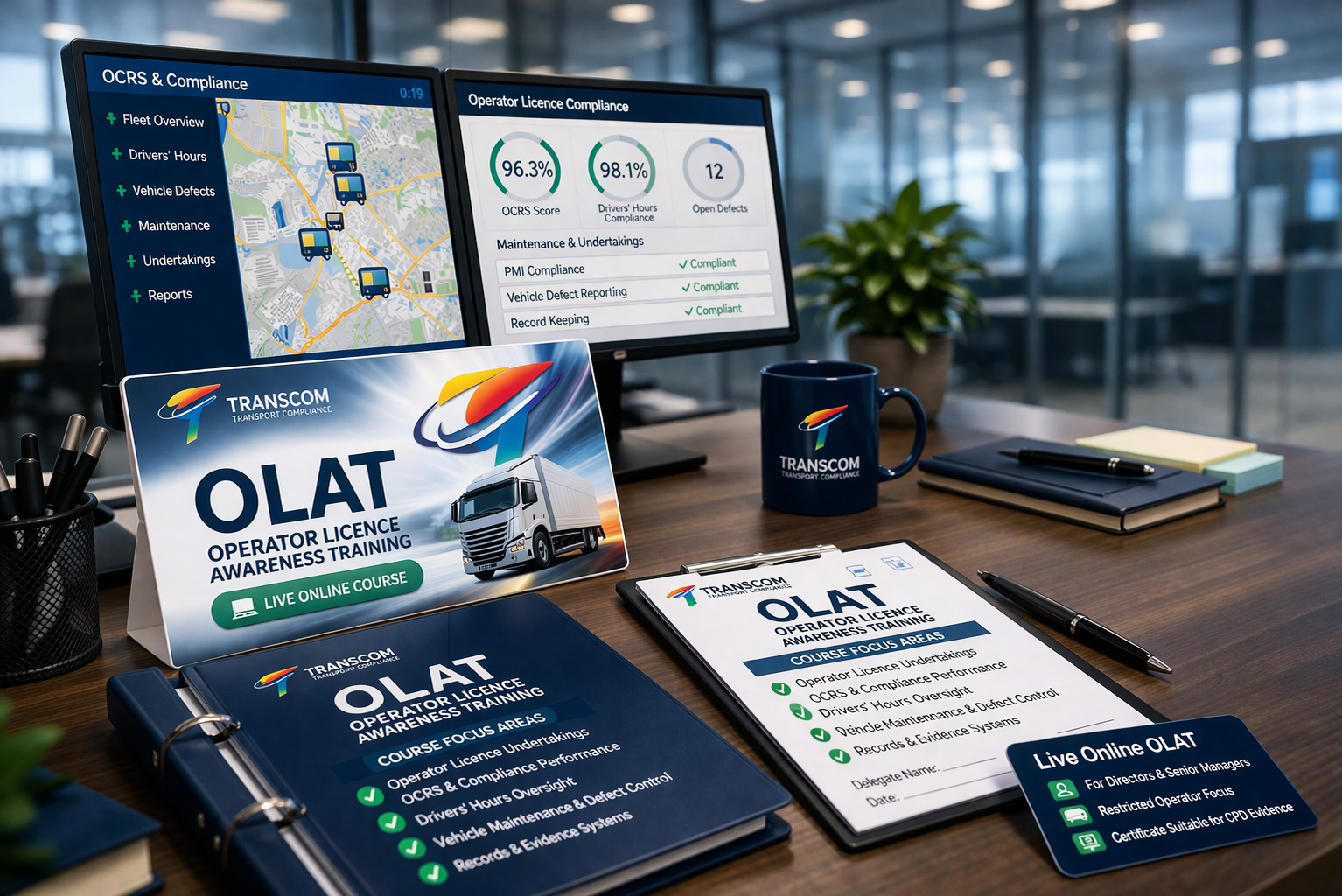
The course focuses on the practical duties behind the licence: operator licence undertakings, vehicle maintenance systems, defect reporting, drivers' hours oversight, OCRS, record keeping, operating centre control and evidence of active management.
For many businesses, the training becomes important when they are applying for an operator's licence, changing management responsibilities, dealing with DVSA contact, responding to compliance concerns or trying to show that the people responsible for the licence understand what is expected.
If you are looking for course dates rather than an explanation, visit Transcom's live online OLAT course page — now running weekday and Saturday sessions.
OLAT stands for Operator Licence Awareness Training. It explains the responsibilities involved in holding, applying for or helping to manage an operator's licence.
In simple terms, it helps people understand what the operator licence actually requires in day-to-day business. It is not just about having a licence disc in the vehicle. It is about making sure the operator has suitable systems, records and management control in place.
The course focuses on the people who make decisions, manage systems or carry responsibility for the licence. That includes directors, business owners, senior managers, restricted operators and compliance leads.
Operator compliance is not just what happens in theory. Operators need records, checks and follow-up actions that can be shown if DVSA, an auditor or the Traffic Commissioner asks questions.
Operator Licence Awareness Training is for people who have responsibility for an operator's licence or who are involved in the systems behind it. It is particularly relevant where the business relies on directors, managers or supervisors to control compliance.
Ask yourself two questions. First: do I carry responsibility for an operator's licence — as a director, manager, supervisor or restricted licence holder? Second: could I confidently explain our licence undertakings, maintenance system, defect reporting process and drivers' hours oversight to a DVSA examiner today? If the answer to the first is yes and the second is no, OLAT is for you. In our experience delivering this course, that combination describes most attendees on the day they book.
Restricted operator licence holders often face a particular risk because they may not need a nominated Transport Manager. That does not remove the operator's responsibilities. The business still needs suitable systems for vehicle maintenance, defect reporting, drivers' hours oversight, record keeping, operating centre control and compliance monitoring.
In a restricted operation, the responsibility often sits directly with the owner, director or senior manager. That makes operator licence awareness especially important. If the person in charge does not understand the undertakings, the business can drift into non-compliance without realising how quickly the risk is building. We see this regularly: the operator is a builder, scaffolder or recycler first and a vehicle operator second — until DVSA or the Traffic Commissioner reminds them which one the licence cares about.
Restricted does not mean low responsibility. A restricted operator may have fewer vehicles than a large haulage company, but the expectation to keep vehicles roadworthy, records controlled and the licence properly managed still applies.
Transcom also provides restricted operator compliance support for operators who need ongoing help keeping maintenance records, defect reports, actions and responsibilities under better control.
OLAT is not automatically required for every operator licence application. However, recent Traffic Commissioner decisions show that the course may be requested, recommended or treated as useful evidence where there are concerns about an applicant's understanding, previous compliance history, restricted operator control or ability to manage the licence responsibly.
This matters because an operator licence application is not just an online form. The applicant must satisfy the Traffic Commissioner that the business can meet the requirements attached to the licence, including maintenance arrangements, financial standing, operating centre requirements, good repute or fitness, and the ability to obey the rules.
Sukhvinder Singh — restricted operator licence application
The decision stated that a future restricted licence application was likely to be looked at positively if the applicant completed an OLAT course from a competent and independent provider and provided proof as part of the application process.
Premier Scaffolding — application refused
The applicant was advised to undertake an Operator Licence Awareness Training course before making any further application.
R A Wood Pallet's Recycling Ltd — fresh application advice
The decision said all directors of the applicant company should demonstrate commitment to compliance by attending an OLAT course before launching a fresh application.
The point is not that training guarantees an application will be granted. It does not. The point is that it can form part of a stronger evidence picture where directors, managers or restricted operators need to show they understand what the licence requires.
If you are applying for a licence and want help reducing avoidable delays, see Transcom's operator licence application assistance. You may also find our guide on why operator licence applications get delayed useful before you submit.
A Traffic Commissioner may look closely at whether the people responsible for an operator's licence understand their duties. Awareness training may become relevant where the issue is not only paperwork, but management understanding, control and commitment to compliance.
Where a matter is already before the Traffic Commissioner or involves formal regulatory proceedings, operators should consider taking independent legal advice. Training and awareness evidence are not a substitute for legal representation where that is needed.
A good operator licence awareness course should focus on the practical areas that create real operator licence risk. The aim is not to bury attendees in theory. The aim is to help them understand what needs to be controlled, checked and evidenced.
DVSA's Guide to Maintaining Roadworthiness explains the responsibilities and systems involved in keeping commercial vehicles roadworthy. GOV.UK's goods vehicle operator licensing guide also makes clear that operators must satisfy the Traffic Commissioner that vehicles will be kept fit and serviceable.
If a Traffic Commissioner letter has asked you to complete operator licence management training, one of the first things to check is whether the provider you choose actually counts. Transcom National Training does. We are an approved provider of the Transport Manager CPC qualification, for both goods vehicle and PCV operations, accredited through Skills and Education Group Awards — placing us firmly within the provider categories the Traffic Commissioners accept for this training.
That means you can book with confidence: the certificate you receive is genuine evidence you can submit, not something you'll need to double-check or justify later.
Virtual course delivery is also fully compliant. Our live online OLAT satisfies the Traffic Commissioners' own criteria for virtual training — covered in full in the virtual OLAT section below.
Whether training is completed in person or online, proof of attendance must usually be submitted to the Office of the Traffic Commissioner (Licensing) within seven days of completing the course — we issue certificates promptly so you can meet that deadline.
Submission deadlines and provider conditions can vary between individual Traffic Commissioner letters. Always check the specific wording in your own correspondence.
OLAT course costs vary by provider, delivery method and group size. Most providers price OLAT as a one-day course, with live online delivery usually cheaper than classroom attendance because there are no venue, travel or accommodation costs. On-site group delivery for several directors or managers is typically priced per day rather than per delegate, which can work out better value for larger teams.
When comparing prices, look past the headline figure and check what you are actually buying: who delivers the course and what their compliance background is, whether it is live training or a recorded video, whether delegates can ask questions about their own operation, and what evidence of completion is provided. Traffic Commissioner decisions have referred to training from a competent and independent provider — the cheapest option is not automatically the one that serves you best as evidence.
For a virtual course, also check whether the provider verifies identity, requires cameras and microphones, monitors attendance, permits live interaction, uses assessment and delivers sufficient participation time. A cheaper course is poor value if its delivery cannot be evidenced against the Traffic Commissioner criteria when the certificate is later relied upon.
Searching for a free OLAT course online? Be careful. There is no recognised free OLAT course, and a free video or PDF is unlikely to carry weight as evidence of commitment to compliance. If the purpose of the training is to support an application or respond to a Traffic Commissioner's concern, the provider and delivery format matter.
For Transcom's current OLAT pricing and dates — including weekday and Saturday sessions — see the live online OLAT course page. On-site delivery for groups is available by arrangement — contact us for a quote.
No. OLAT does not replace the Transport Manager CPC. The Transport Manager CPC is a formal professional qualification required for nominated Transport Managers on Standard National and Standard International licences.
The awareness course is different. It is for directors, senior managers, restricted operators and other responsible people who need to understand the operator licence duties and the systems that support compliance.
If you are a qualified Transport Manager who needs to refresh your professional knowledge, see Transcom's Transport Manager CPC Refresher training. If you are working towards the qualification itself, see our guide on how hard the Transport Manager CPC exam really is.
No. OLAT is not Driver CPC. Driver CPC is periodic training for professional drivers. OLAT is management-level operator licence awareness training for people responsible for compliance systems, licence undertakings and operational control.
Drivers need to understand their own duties, but this course is aimed at the people responsible for making sure the business has the right systems in place. That includes managers checking maintenance records, directors understanding undertakings, and restricted operators keeping proper control of the licence.
Yes. Operator Licence Awareness Training can be delivered live online, but a virtual course must still operate as genuine instructor-led training. It cannot be reduced to a passive webinar, a recording or an unverified login followed by a certificate.
Traffic Commissioner decisions continue to state that a virtual online course must satisfy the criteria established by the Traffic Commissioners. Where OLAT is being completed to meet an undertaking, support an application or respond to regulatory concerns, the operator must be able to show that the delegate genuinely attended and participated in suitable training.
Do not assume that every course advertised as "online OLAT" meets the required standard. A course that cannot verify identity, attendance, live visibility, interaction, assessment and sufficient participation time may not provide reliable evidence that the training requirement has been met.
A certificate is issued only when the required identity, attendance, participation and assessment standards have been met. A delegate who joins on unsuitable equipment, keeps the camera off, cannot be heard, leaves the training, fails to participate or does not complete the assessment cannot be recorded as having successfully completed the course.
This protects the delegate as well as the provider. If a Traffic Commissioner, DVSA examiner or licensing caseworker later asks for evidence, the certificate should represent real, verifiable participation in a properly delivered course — not simply payment for access.
Transcom National Training provides a live online OLAT course for directors, senior managers, restricted operator licence holders and compliance staff across the UK, with weekday and Saturday sessions available.
Current Traffic Commissioner decisions continue to require virtual courses to satisfy the criteria established by the Traffic Commissioners. See the 2026 Forest Coaches decision and the published GOV.UK virtual-training criteria.
After completing OLAT, delegates should receive a certificate of attendance or completion. This can be retained as part of the operator's training, CPD and compliance records.
Where training has been requested, recommended or is being used to support an application or compliance position, the certificate can help show that relevant people have attended operator licence awareness training.
A certificate does not guarantee that an operator licence application will be granted, and it does not repair weak systems on its own. It should sit alongside proper maintenance arrangements, accurate records, clear responsibilities and active management control.
If you are unsure whether your systems would stand up to scrutiny, Transcom's Operator Licence Compliance Health Check and Audit can help identify weaknesses in maintenance systems, defect reporting, drivers' hours oversight, records and management control.
Waiting until OLAT is requested is rarely the strongest position. If directors, managers or restricted operators already know they have gaps in understanding, recent management changes, weak records, maintenance concerns or an operator licence application underway, completing training earlier can help show a more proactive approach.
That does not mean every operator needs it immediately. It means that where management awareness is a genuine risk, training should not be left until the business is already under pressure.
Compliance training does not have to cost a fortune. Non-compliance can.
Transcom's Operator Licence Awareness Training course is delivered live online for directors, senior managers, restricted operator licence holders and transport compliance staff — with both weekday and Saturday sessions available.
The course is designed to help delegates understand operator licence undertakings, OCRS, drivers' hours oversight, vehicle maintenance systems, defect reporting, record keeping and evidence of active management.
A practical guide to transport manager appointment: eligibility, operator licence steps, legal duties and evidence needed for compliant daily operations.

Internal versus external transport manager: assess control, cost, competence and licence risk before choosing the right arrangement for your fleets.

Understand DVSA investigation triggers, the evidence examiners may seek, and the practical controls that help operators protect their licence and standing.

Vehicle maintenance compliance protects your operator licence. Learn how to set effective inspections, defect reporting and maintenance controls. Daily.

Transport Manager CPC exam dates for 2026 and 2027, including Road Haulage and Passenger Transport sittings, online MCQ and Case Study dates, and the latest confirmed timetable from Skills and Education Group Awards.

Understand operator licence financial standing, acceptable evidence and controls that help operators protect their licence and satisfy Traffic Commissioners.