

Operator Licence Awareness Training Online
Operator licence awareness training online helps directors and transport managers understand undertakings, evidence and daily compliance responsibilities.
A good repute operator licence position is not protected by clean-looking paperwork or the fact that DVSA has not visited recently. It is protected by trust, conduct, compliance systems and evidence.
For standard operator licence holders and transport managers, good repute is a core licensing requirement. For restricted operator licence holders, the closely linked issue of fitness is just as important. In both cases, the Traffic Commissioner needs to be satisfied that the operator can be trusted to run vehicles safely, legally and responsibly.
The Senior Traffic Commissioner’s statutory document summaries, published in April 2026, are a useful reminder for operators. The summaries do not replace the full statutory documents, but they make the key principles easier to understand.
Written by Gareth Wildman, Director and Senior Lead Instructor, Transcom National Training. This guide is reviewed when Traffic Commissioner guidance, operator licensing requirements or official GOV.UK source material changes.
Gareth Wildman is Director and Senior Lead Instructor at Transcom National Training, a specialist UK transport training and compliance provider.
Gareth works with operators, transport managers, professional drivers and restricted licence holders on operator licence compliance, Driver CPC, Transport Manager CPC, Operator Licence Awareness Training and practical compliance support.
Transcom National Training is a JAUPT Approved Centre, delivering compliance-focused transport training designed to help operators understand their responsibilities and evidence safer, more controlled transport operations.
In operator licensing, good repute means that the Traffic Commissioner can trust the operator, directors and transport manager to act honestly, responsibly and within the rules.
It is not only about criminal convictions. It can also involve fixed penalties, conduct, maintenance failures, tachograph issues, driver management, financial standing, undertakings, honesty during applications and the way an operator responds when something goes wrong.
A good repute issue can therefore be much wider than many operators realise. It can arise from poor systems, repeated failures, ignored warnings or a pattern of non-compliance that suggests the business is not properly controlled.
This first section explains what good repute means, who it applies to, what can damage it and how operators can protect their position before the Traffic Commissioner is asking questions.
An operator licence is not simply permission to run vehicles. It is permission based on trust. The Traffic Commissioner grants that permission on the basis that the licence holder will comply with the law, meet undertakings and operate safely.
If that trust is damaged, the licence can be placed at risk. Depending on the seriousness of the case, regulatory action can include a warning, conditions, curtailment, suspension, revocation or disqualification.
This is why operators should treat good repute as an active compliance issue, not just a legal phrase buried in operator licensing guidance.
Good repute is especially important for:
Restricted operator licence holders should not ignore this subject. While good repute is a specific standard licence requirement, restricted operators must still be fit to hold a licence and must still show that they can obey the rules, maintain vehicles properly and comply with undertakings.
A restricted licence does not mean reduced responsibility. Restricted goods vehicle operators still need proper maintenance systems, driver controls, records, financial resources and evidence that the operation is being managed properly.
Many operators only start thinking about good repute after a DVSA encounter, prohibition, Public Inquiry call-up letter, failed maintenance investigation, complaint or serious compliance failure.
That is the wrong time to start building evidence.
The Traffic Commissioner will not only look at the incident itself. They may look at the systems behind the incident, the history of the operator, the quality of management control, whether undertakings have been kept and whether the operator acted honestly and quickly once the problem became known.
In plain English: a mistake may be survivable. A weak system, poor response or lack of honesty can be much harder to defend.
The following issues can damage good repute or raise concerns about whether an operator is fit to hold a licence:
Good repute and fitness are closely linked, but they are not exactly the same.
Good repute is about trust, conduct, honesty, convictions, fixed penalties, compliance history and whether the operator or transport manager can be relied upon.
Fitness is about whether the licence holder can obey the rules and comply with the requirements of the operator licence, including undertakings and conditions.
Standard licence holders must pay close attention to both good repute and professional competence. Restricted licence holders should pay close attention to fitness, because the absence of a nominated transport manager does not remove the duty to operate safely and legally.
A transport manager must be more than a name on the licence. They must be able to exercise effective and continuous management of the transport operation.
That means being involved in the systems that control maintenance, drivers’ hours, tachographs, driver licensing, Driver CPC, walkaround checks, defect reporting, record keeping and corrective action.
External transport managers need to be especially careful. The arrangement must allow enough time, access, authority and independence for the role to be real. If a transport manager remains named on a licence but cannot properly manage the operation, their own good repute may be exposed.
Transcom provides Transport Manager CPC Refresher training for transport managers who need to update their knowledge, strengthen CPD evidence and reinforce professional responsibility.
Good repute is protected by evidence, not assumptions. Operators should be able to produce clear records showing that systems are working and that problems are being dealt with.
The strongest operators are usually not the ones who claim everything is fine. They are the ones who can show what they checked, what they found, what they fixed and how they stopped the same issue happening again.
Check the licence type, authorised vehicles, operating centres, undertakings, transport manager details and any conditions attached to the licence.
Look at safety inspection dates, inspection quality, defect reporting, repair evidence, brake testing, MOT outcomes and repeat defects.
Review licence checks, Driver CPC status, tachograph card checks, drivers’ hours records, working time records and infringement follow-up.
Directors, transport managers, fleet supervisors, admin staff and drivers all play a part in operator licence compliance.
Finding a problem is not the end of the process. Operators need to record what action was taken, who was responsible and when the issue was closed.
A properly structured operator licence compliance audit can identify weaknesses before DVSA, the Office of the Traffic Commissioner or the Traffic Commissioner identifies them for you.
The second part of this article looks at the April 2026 statutory document summaries and why they reinforce the need for operators to understand good repute, fitness and evidence-led compliance.
In April 2026, the Traffic Commissioners announced the publication of new Senior Traffic Commissioner statutory document summaries.
These summaries are designed to help operator licence holders, transport managers, applicants and vocational drivers understand operator licensing and driver conduct requirements more easily.
They do not replace the full statutory documents. Operators should still read the full Senior Traffic Commissioner statutory guidance and statutory directions where detailed guidance is needed.
The statutory document summaries matter because they bring the key principles of operator licensing into clearer focus.
Good repute, fitness and professional competence are not abstract legal terms. They are practical standards that affect whether an operator can obtain, keep or continue using an operator licence.
For operators, the message is clear: holding a licence is not the end of the compliance journey. It is the start of an ongoing obligation.
The Traffic Commissioner may expect an operator to show that the business is being managed properly, that undertakings are being met and that transport risk is controlled through real systems.
The new summaries make the guidance easier to understand, but they do not reduce the standard expected from operators or transport managers.
That matters because some operators treat compliance guidance as something to read only after a problem has already developed. That is the wrong approach.
The better approach is to use the summaries as a prompt to review your own systems now:
Operators should not read the statutory document summaries as a box-ticking exercise. They should use them as a practical trigger for review.
Start with the summary that relates to the issue you are reviewing, such as good repute and fitness, transport managers, finance, operating centres, vocational driver conduct or regulatory action.
Ask whether your current systems would satisfy the expectations described. If the answer is “probably” or “I think so”, that is a warning sign. Compliance should be evidenced, not guessed.
The summaries are useful, but they are not a substitute for the full statutory guidance and directions. Use the full documents where detail matters.
Keep a record of what was reviewed, what was found and what action was taken. This creates evidence of active management.
If you find a weakness, deal with it. Operators are usually in a stronger position when they can show that they identified a problem, acted on it and improved the system.
Training alone does not guarantee good repute. However, targeted training can help operators and transport managers understand their responsibilities and evidence that they are taking compliance seriously.
Transcom National Training supports operators across the UK with live online and practical compliance-focused training, including:
If your systems have not been reviewed recently, now is the time to check them. The strongest position is to identify weaknesses before DVSA or the Traffic Commissioner does.
Transcom National Training provides practical, transport-led support for operators, transport managers and restricted licence holders across the UK.
The operators in the strongest position are usually the ones who can show what they do before there is a problem.
They can produce maintenance records, defect reports, tachograph analysis, driver training records, financial evidence, audit findings and corrective action.
The weakest position is to wait until DVSA, the Office of the Traffic Commissioner or the Traffic Commissioner asks for evidence and only then try to piece the story together.
Good repute is earned, evidenced and maintained. It is not protected by hope.
Good repute means that the Traffic Commissioner can trust the operator, directors or transport manager to act honestly, responsibly and within the rules. It includes conduct, compliance history, relevant convictions, fixed penalties and other matters that may affect trust.
Yes. Where good repute is lost or serious compliance concerns arise, the Traffic Commissioner may take regulatory action. Depending on the case, this can include curtailment, suspension, revocation or disqualification.
Good repute is a specific requirement for standard licence holders, but restricted licence holders must still be fit to hold a licence and must still show that they can obey the rules, keep vehicles roadworthy and comply with undertakings.
Yes. Transport managers must be of good repute and professionally competent. They must also exercise effective and continuous management of the transport operation.
Useful evidence includes maintenance records, defect reports, tachograph analysis, infringement follow-up, driver licence checks, Driver CPC records, transport manager review notes, financial standing evidence, training records and audit reports.
No. The summaries are intended to make the key principles easier to understand, but operators should still use the full Senior Traffic Commissioner statutory guidance and directions where detailed guidance is needed.
Training can help where it addresses the weakness identified. However, training should be supported by real operational change, proper records and evidence that the operator is actively managing compliance.
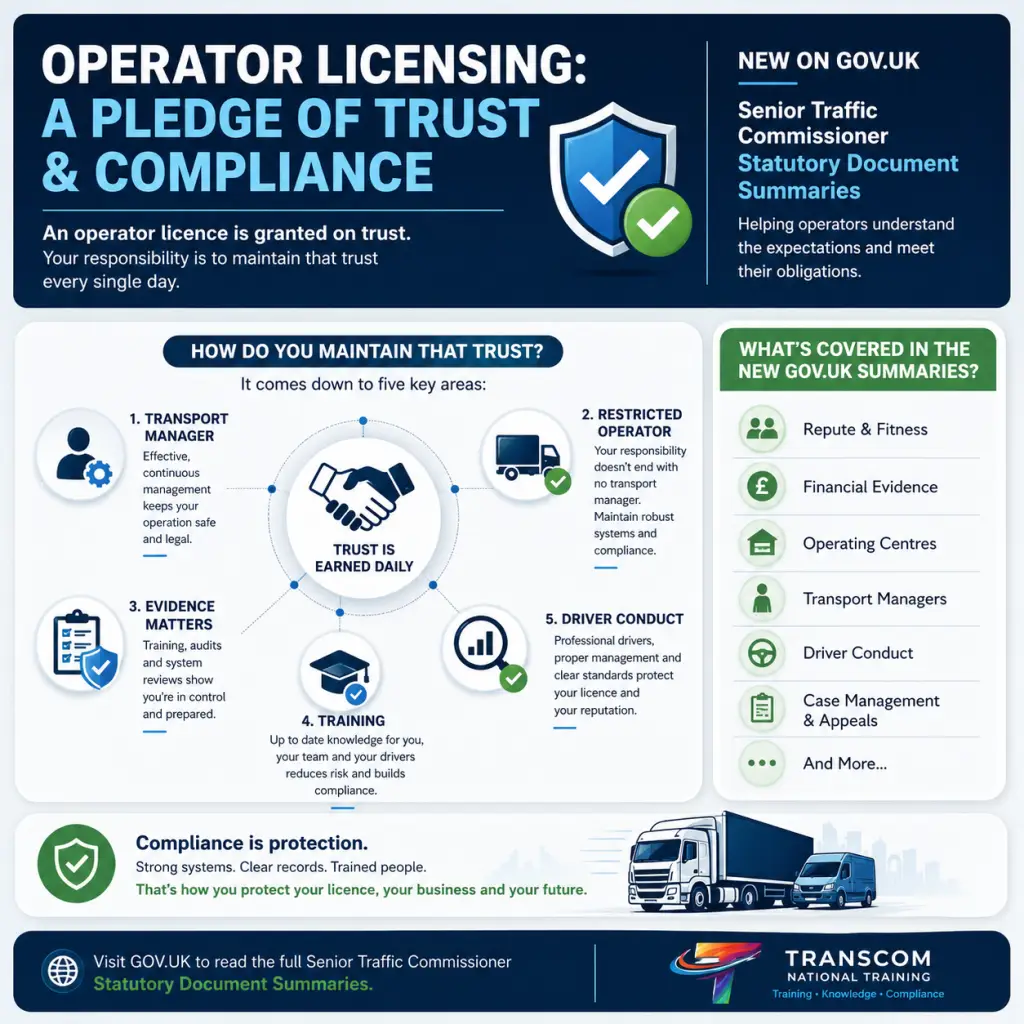
Operator licence awareness training online helps directors and transport managers understand undertakings, evidence and daily compliance responsibilities.

A two day transport manager refresher gives UK operators focused CPD on licence duties, audit evidence and practical controls that protect compliance daily.

Practical help with CPC case study questions: learn how to identify compliance risks, apply rules and write clear, evidence-based exam answers with care.

Transport manager CPC home study: understand the demands, choose the right support and prepare for exams with practical UK compliance knowledge for role readiness.

Choose an online transport manager CPC course with live expert tuition, practical exam support and the knowledge required to protect an operator licence.
Transport Manager CPC Exams Online: A Complete Candidate Guide Written and verified by Gareth Wildman — qualified Transport Manager, Centre Manager and Lead Trainer at
|
Uploaded
Failed
|
 |