

Restricted Licence Conditions for UK Operators
Understand restricted licence conditions, how they affect daily operations and the evidence needed to protect your UK operator licence during an inquiry.
Everything a UK Transport Manager needs to know about continuing professional development: what the Senior Traffic Commissioner's Statutory Document No. 3 actually says, the five occasions when you must produce CPD evidence, what counts as credible evidence, and how to build a CPD file that protects your Good Repute. Every claim in this guide is referenced to official GOV.UK guidance or Upper Tribunal case law.
Continuing Professional Development (CPD) is the term the Senior Traffic Commissioner uses to describe "the learning activities professionals engage in to develop and enhance their abilities". For Transport Managers, the purpose is spelled out in Statutory Document No. 3: Transport Managers: CPD "promotes learning to be conscious and proactive, rather than passive and reactive."
That single sentence explains the entire regulatory attitude to TM training. A Transport Manager who waits until a DVSA investigation to discover that brake testing standards changed, or that a tachograph rule has been updated, is managing reactively — and reactive management is precisely what Traffic Commissioners treat as evidence that a TM is no longer exercising their statutory duty.
CPD is not one specific course. The statutory guidance says it "can take many forms such as training workshops, conferences and events, e-learning programs, best practice techniques and ideas sharing". However — and this matters enormously in practice — the guidance also sets a clear evidential benchmark for TMs whose CPD has lapsed, which we cover in section 4.
A Transport Manager's duty comes from paragraph 14A of Schedule 3 to the Goods Vehicle (Licensing of Operators) Act 1995 and Article 4 of assimilated Regulation (EC) No 1071/2009: to "effectively and continuously manage the transport activities" of the licence holder. Statutory Document 3 makes clear that this requires more than good repute, a certificate and declared hours — the TM "must be capable of actually managing the transport operation effectively".
The statutory guidance identifies three ingredients Traffic Commissioners look for beyond the certificate: knowledge and skills (more than the formal qualification), impact (being a recognised key person who can influence compliance decisions and deal with contractors), and decision making (close enough to drivers to influence behaviour, senior enough to influence resources and directors).
When you sign the TM1 declaration you commit to fulfilling the statutory responsibilities in the hours you declared. The Upper Tribunal in 2016/059 Adrian John Dalton was blunt: if a TM cannot discharge the duty on the declared hours, they should increase their input or resign. You can delegate tasks — but never responsibility.
Knowledge currency sits inside this duty. Statutory Document 3 states that a Traffic Commissioner "might legitimately be concerned as to the currency of the nominated CPC holder's professional knowledge", and expects every CPC holder to know the conditions and undertakings on the licences they are named on, and the most serious infringement provisions affecting repute. Where currency is in doubt, the documented remedy is a formal undertaking to complete refresher training within a specified time, with evidence of attendance produced.
This is the most practically important passage in Statutory Document 3, and the one most Transport Managers have never read. The Senior Traffic Commissioner has identified five specific instances when a TM "should expect to provide evidence of their capacity to meet the statutory duty through continuing professional development":
Notice that three of the five triggers arrive with no warning: a licence renewal, a new nomination, or a Public Inquiry following DVSA attention. By the time the question is asked, it is too late to build the evidence. A TM called to Public Inquiry with an empty CPD record is asking the Traffic Commissioner to take current competence on trust — and as our guide to Good Repute and the Traffic Commissioner explains, trust is exactly what is being re-assessed at that point.
Statutory Document 3 accepts a broad range of learning — workshops, conferences, e-learning, best-practice sharing. But it also sets a specific benchmark for the situation most TMs are actually in: "If there has been some time since CPD was undertaken the starting point for evidence would be for the completion of a 2 day transport manager CPC refresher course", run by one of four categories of provider:
Whether your CPD is a two-day refresher, a conference, or structured e-learning, the same qualities determine whether a Traffic Commissioner or auditor will accept it:
| Test | What it means | What fails it |
|---|---|---|
| Relevant | Tied to your core duties: licensing undertakings, maintenance systems, drivers' hours, tachographs. | Generic management training with no O-licence content. |
| Recent | Current enough to capture regulatory change — brake testing standards alone changed materially in 2025. | A certificate from a decade ago, or "years of experience" with nothing documented. |
| Substantial | Enough depth to genuinely refresh knowledge; the statutory starting point is two days. | A 40-minute webinar presented as a full refresher. |
| Verifiable | Independently evidenced: named provider, dated certificate, course agenda. | Self-certified reading logs with no third-party corroboration. |
The difference between a TM who survives scrutiny and one who does not is rarely knowledge — it is documentation. Statutory Document 3 lists, among the questions asked when assessing a TM: "What continuing professional development has the transport manager undertaken? How recently has the transport manager received training on his or her CPC duties? Details of the course, provider and certificate of attendance may be required." Your file should answer those questions before they are asked. Keep, for every CPD activity:
The reflection point deserves emphasis. Traffic Commissioners assess whether management is continuous and effective — not whether you sat in a room. A certificate plus a documented change to your compliance systems is far stronger evidence than a certificate alone, because it demonstrates the "conscious and proactive" learning the statutory guidance describes.
CPD only matters because of what it protects: your ability to demonstrate continuous and effective management. Statutory Document 3 and the DVSA's operator compliance audit framework converge on the same practical picture of what an effective TM actually controls day to day:
Two structural points from the statutory guidance are worth knowing. First, the duty applies equally to all operators regardless of size — the Upper Tribunal confirmed in the Eddie Stobart appeal that the licensing system's "relationship of trust" makes no allowance for scale. Second, oversight runs both ways: an operator must supervise and monitor its Transport Manager, checking maintenance inspections, test pass rates, prohibitions, OCRS and drivers' hours arrangements. A TM whose employer never asks questions should treat that as a risk, not a compliment.
Statutory Document 3 publishes indicative weekly hours a TM might be expected to devote per licence, as a starting point for the Traffic Commissioner's assessment. If you are named on multiple licences, or your declared hours fall below these figures, expect the CPD-evidence question (trigger 3 above) to follow:
| Number of vehicles | Indicative hours per week |
|---|---|
| 2 vehicles or fewer | 2 – 4 hours |
| 3 to 5 vehicles | 4 – 8 hours |
| 6 to 10 vehicles | 8 – 12 hours |
| 11 to 14 vehicles | 12 – 20 hours |
| 15 to 29 vehicles | 20 – 30 hours |
| 30 to 50 vehicles | 30 hours – full time |
| More than 50 vehicles | Full time, plus additional assistance |
Additional hours may be required for trailers, and external Transport Managers are limited by law to a maximum of 4 licence holders and 50 vehicles in total. External and remote TMs face a structurally harder evidential task — visits to operating centres, access to records and genuine authority all come under scrutiny — which is why a current, documented CPD record matters even more for external appointments.
Statutory Document 3 is built on Upper Tribunal decisions, and three of them define the modern expectations on Transport Managers:
The Tribunal held that "whether or not an individual has the character, personality, ability and leadership qualities... to effectively and continuously manage the transport activities as a transport manager is a factor which can, properly, be taken into account when assessing good repute." In plain terms: a stale knowledge base is not just a training gap — it can cost you your Good Repute, and with it your ability to act as a TM at all.
Upon nomination, a TM "becomes responsible for effectively and continuously managing the company's regulatory compliance and should make sure all systems meet the legislative requirements." Where a TM fails to meet the standard, the correct regulatory response is a finding against that TM's repute — the consequences attach to you personally, not only to the operator.
A TM can delegate tasks, but "this does not shift their responsibility and they must ensure that the delegated tasks are carried out properly." A compliance clerk running your tacho analysis does not reduce what you must know — it increases it, because you must be competent to supervise the work.
There is also a rehabilitative angle worth knowing: where a TM has been disqualified, Statutory Document 3 notes that a Traffic Commissioner "might also consider the applicability of a rehabilitation measure at the end of a disqualification period, for instance, a 2-day CPC refresher course." The same course that evidences competence going forward is the regulator's own preferred route back for those who have lost it.
The strongest argument for structured, recent CPD is simply how fast the compliance landscape moves. Recent examples every TM should already have absorbed into their systems:
Each of these is exactly the kind of change a Traffic Commissioner expects a competent TM to know about before a DVSA encounter reveals otherwise — the "conscious and proactive" standard in action.
You do not need a training department to run credible CPD. A realistic annual pattern for a working TM, mapping each activity to the evidence it produces:
| When | Activity | Evidence produced |
|---|---|---|
| Quarterly | Read the Traffic Commissioners' and DVSA updates (Moving On blog, GOV.UK publications); note anything requiring a system change. | Dated entries in your CPD log; amended procedures. |
| Quarterly | Self-audit one compliance area (maintenance, drivers' hours, tachographs, licensing undertakings) against current guidance. | Audit note and action list on file. |
| Annually | Attend at least one structured external event: trade association seminar, professional body conference or compliance workshop. | Certificate/attendance record plus agenda. |
| Every 2–3 years, or after any lapse | Complete a 2-day Transport Manager CPC refresher course — the statutory guidance's own starting point for evidence. | Certificate, syllabus and provider credentials — the core of your file. |
| Ongoing | Record every activity in a one-page CPD log with a short reflection on what changed as a result. | A single document that answers the Traffic Commissioner's questions before they are asked. |
No. There is no formal expiry or renewal cycle for the TM CPC itself. However, Traffic Commissioners assess the currency of your professional knowledge, and Statutory Document 3 sets out five specific occasions when you must evidence CPD — including when your qualification is more than 10 years old.
No fixed annual hours are mandated. The statutory guidance asks for learning that is conscious and proactive rather than passive and reactive. In practice a mix of regular self-directed updating plus periodic structured training meets the standard — with a 2-day refresher course as the documented starting point where there has been a gap.
It is the statutory duty on every nominated TM to effectively and continuously manage the transport activities of the licence holder — in practice, demonstrable day-to-day control of maintenance systems, brake testing, defect reporting, drivers' hours and tachograph compliance, evidenced by records. It applies equally to all operators regardless of fleet size.
Statutory Document 3 names four categories: trade associations (Logistics UK, RHA, BAR, CPT); professional bodies (IoTA, CILT, SOE, IRTE); approved exam centres offering the relevant TM CPC qualification; and road transport solicitors' firms with significant regulatory experience.
No. They are separate regimes. Drivers complete 35 hours of periodic training every 5 years for Driver CPC; TM CPD has no fixed cycle and TM refresher courses do not contribute to a driver's periodic hours.
Yes. External TMs are limited to 4 licence holders and 50 vehicles in total, and nominations across multiple licences (or on reduced hours) are one of the five statutory triggers for producing CPD evidence. Expect scrutiny of operating centre visits, record access and genuine authority as well.
Statutory Document 3 notes that a Traffic Commissioner may consider a rehabilitation measure at the end of a disqualification period — giving a 2-day CPC refresher course as the example. It is not guaranteed, and deliberate misconduct may attract long or indefinite disqualification instead.
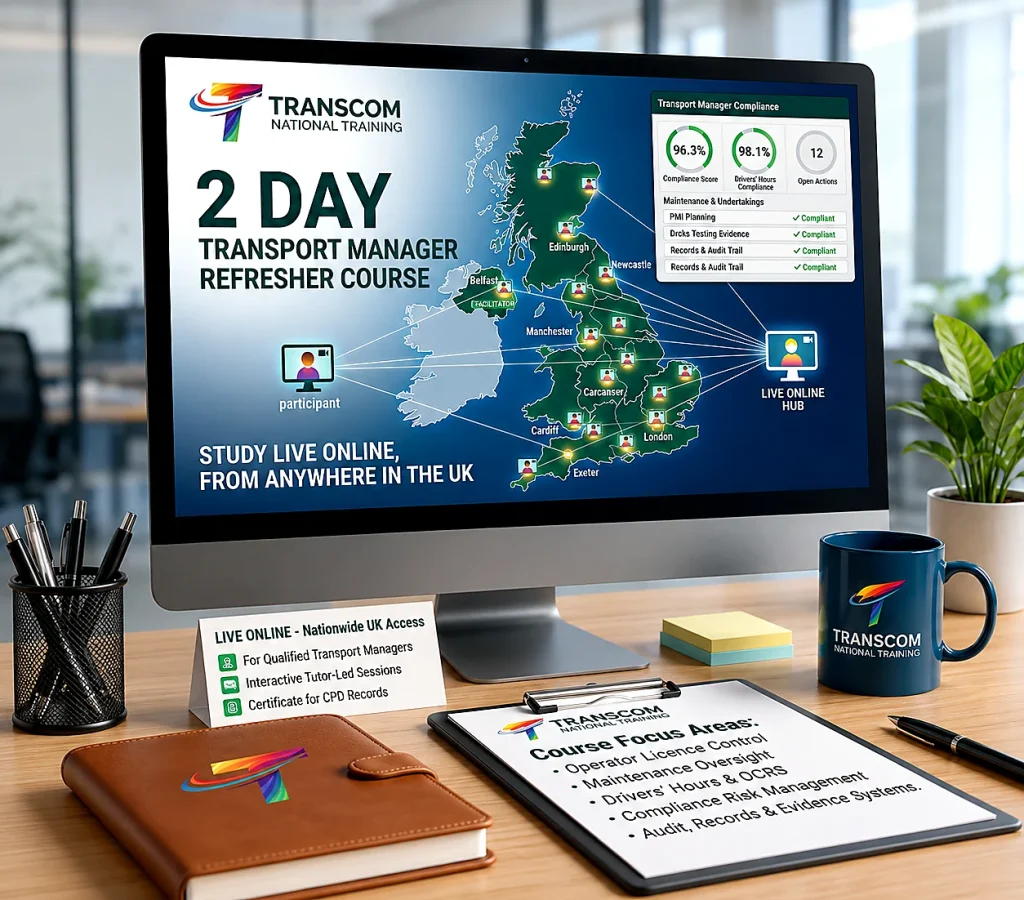
Statutory Document 3 names the 2-day refresher as the starting point for CPD evidence. Our live online Transport Manager CPC Refresher Course delivers it — trainer-led, fully updated for 2026, with the certificate and agenda your evidence file needs.
Explore the 2-Day Refresher CourseJAUPT Approved Centre AC02755 • Road Haulage & PCV
Understand restricted licence conditions, how they affect daily operations and the evidence needed to protect your UK operator licence during an inquiry.

Strengthen tachograph compliance through clear checks, accurate records and accountable management that protects your operator licence on every journey.

Compare a standard versus restricted licence for UK goods operators: scope, transport manager rules and the compliance duties that protect your licence.

Build a CPC exam revision timetable that turns the Transport Manager syllabus into confident, structured preparation for examination day with purpose.

Operator licensing is not a formality. See how licence type, undertakings, transport management and evidence help protect a lawful UK fleet every day.

Transport compliance protects more than paperwork. Build evidence, control risk and meet operator licence duties with practical, accountable systems daily.
|
Uploaded
Failed
|
 |