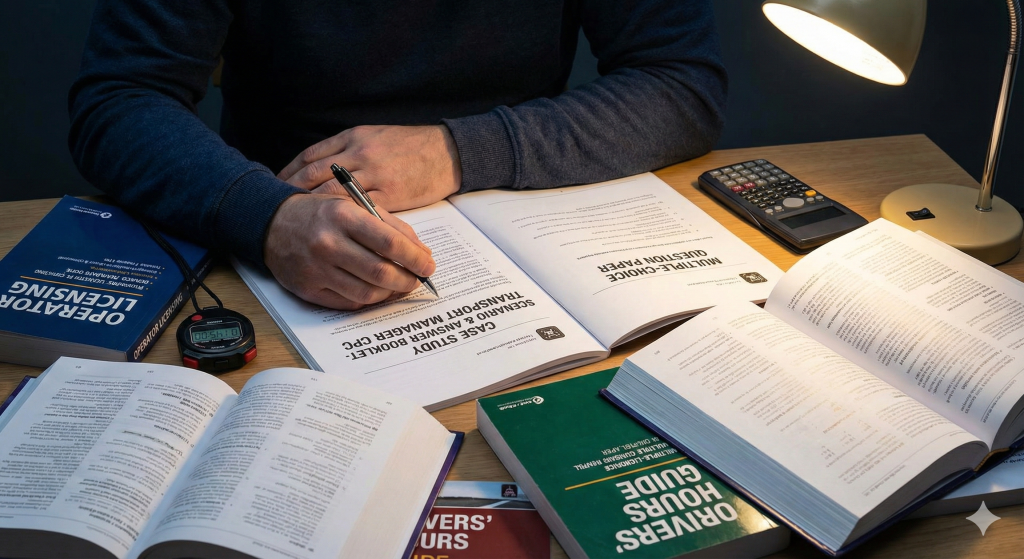
How Hard Is It to Pass the Transport Manager CPC Exam?
The Transport Manager CPC is achievable, but it is often underestimated. It is not just a memory test. It checks whether you can understand transport law, operator licensing, compliance systems, finance, vehicle operations and exam scenarios well enough to apply them under pressure.
This guide is written from the classroom, not from theory. It explains why candidates struggle, what the pass rates really look like, how the multiple-choice and case study assessments differ, and how to prepare properly — whether you are sitting with CILT or Skills and Education Group Awards.
Quick answer: is the Transport Manager CPC exam hard?
Yes, most candidates find the Transport Manager CPC challenging. It is hard because the syllabus is broad, the case study assessment is time-pressured, and the exam rewards precise, legally correct, structured answers. It is not impossible, but it is not something to treat casually.
From training candidates every week, the pattern is consistent: the people who struggle most are usually not unintelligent. They fail because they underestimate the volume of knowledge, rely too heavily on workplace experience, or never practise answering case study questions for marks under timed conditions.
Fastest improvement: practise timed case study answers, learn how marks are awarded, tab your notes properly, and focus on short, clear points rather than long essay-style answers. If one subject keeps blocking you, a one-to-one study session with a tutor who's actually trained to teach — not just qualified in the subject — and who has sat these exams themselves is usually faster than another week of circling the same notes.
Key takeaways
- It is broad: you need knowledge of law, compliance, finance, operations, road safety and management control.
- There are two parts: multiple-choice questions and case study questions — and the case study fails more candidates.
- Open-book does not mean easy: the case study assessment still requires speed, structure and application.
- Real-world experience helps, but it is not enough: the exam expects the legally correct answer, not just “what happens in our yard”.
- Targeted help beats general panic: most struggling candidates have one or two weak subjects, not twenty.
- If it doesn't go to plan first time on the live course, it isn't the end of the road: our Second Chance Guarantee gives 5-day live course candidates a free resit place — see below.
- Support should continue after the exam: passing the CPC is only the start of becoming an effective Transport Manager.
Is the Transport Manager CPC exam hard?
Yes. The Transport Manager CPC exam is hard for many candidates because it covers a wide professional knowledge base and asks you to apply that knowledge in assessment conditions. The qualification sits at the point where transport operations, law, finance and management control meet.
GOV.UK explains that vehicle operators with a Standard National or Standard International operator’s licence need to have a Transport Manager. GOV.UK also explains that you need the Transport Manager Certificate of Professional Competence to become a Transport Manager, and that the route depends on whether you are qualifying for road haulage or passenger transport.
Blunt truth
If your plan is to skim the notes, hope your transport experience carries you, and look everything up in the case study, you are taking a risk. Open-book helps prepared candidates. It does not rescue candidates who have not learned the subject. We see this in mock papers every month: the candidate who has to search their notes for everything runs out of time long before the marks run out.
What is the Transport Manager CPC pass rate?
There is no single official, regularly published national pass rate for the Transport Manager CPC, which is why you will see different figures quoted around the internet. Pass rates vary by awarding body, by sitting and — most of all — by how candidates prepared. Treat any site quoting one precise universal percentage with caution.
What we can tell you from delivering this training full time is more useful than a single number:
The case study fails more people
Of the resit candidates who come to us, the large majority have failed the case study paper, not the multiple-choice. Knowledge gets candidates through part one; technique decides part two.
Near-misses are common
Many failed candidates miss by a small margin. That is usually one or two weak subjects — typically calculations or answer structure — not a general lack of ability.
Prepared candidates pass
Candidates who complete structured training, practise timed mock questions and fix their weak subjects before exam day pass at a far higher rate than candidates who self-study without feedback.
If you have already failed or narrowly missed a paper, do not restart the whole syllabus from page one. Identify the subject that cost you the marks and deal with it directly — that is exactly what our 1-hour Transport Manager CPC study session is for. And if you sat our live 5-day Road Haulage course and it was a near-miss, our Second Chance Guarantee means you don't have to fund a full resit course out of your own pocket to try again.
What makes the Transport Manager CPC difficult?
The exam feels difficult because it combines breadth, detail and time pressure. You are expected to know enough about several technical areas to answer questions accurately and apply the right decision-making process.
The syllabus is wide
You are dealing with operator licensing, drivers’ hours, tachographs, working time, maintenance, road safety, finance, business management and legal responsibilities.
Knowledge alone is not enough
The case study assessment checks whether you can apply the right point to the scenario, not simply remember a definition.
Marks are won through structure
Clear numbered points, calculations with workings and answers matched to command words usually perform better than vague paragraphs.
Subjects candidates often underestimate
Candidates expect drivers’ hours and operator licensing to be difficult, but in our classrooms the subjects that consistently surprise people are business finance, vehicle costing, scheduling, documentation and legal structure. These areas appear in case study questions where you need to show method and reasoning, not just recall. They are also the most common topics learners book one-to-one study support for.
Common myths that cause candidates to fail
Myth 1: “It is open-book, so I can just look up the answers.”
Reality: open-book does not mean easy. You still need to know where information sits, what the question is asking and how to turn that information into marks quickly. If you spend the exam learning the topic for the first time, you will lose time.
Myth 2: “I have worked in transport for years, so I do not need to study.”
Experience helps, but it's not the same thing. The exam expects the correct legal and technical answer, and real-world habits aren't always what the syllabus or marking scheme is looking for. Some of the hardest resit conversations we have are with experienced operators who answered from the yard, not from the law.
Myth 3: “I only operate in the UK, so I can ignore international topics.”
Not quite. UK-only candidates can still be assessed on wider syllabus areas — GOV.UK's own list of knowledge areas includes paperwork needed to take goods or passengers out of the UK. Skipping topics because they don't feel relevant to your current job is a good way to lose marks you didn't need to.
Myth 4: “The case study is just common sense.”
This is where a lot of otherwise capable candidates come unstuck. The case study rewards structured application, time control and hitting the relevant points — common sense is useful, but on its own it isn't exam technique.
Transport Manager CPC exam format: multiple-choice and case study
The Transport Manager CPC assessment is in two parts: multiple-choice questions and case study questions. You have to pass both parts to pass the exam. Both the CILT and Skills and Education Group Awards routes follow this two-part structure, but always check the instructions for the awarding organisation and sitting you are booked onto.
| Assessment | What it tests | Why candidates lose marks | How to prepare |
|---|---|---|---|
| Multiple-choice questions | Broad syllabus knowledge, legal facts, definitions, rules and core professional understanding. | Weak revision, confusing similar rules, guessing between close answers or missing wording in the question. | Revise across the full syllabus, practise topic questions and check why each wrong answer is wrong. |
| Case study questions | Application of knowledge to a scenario, including calculations, management decisions, evidence and responsibilities. | Poor structure, not answering the command word, weak calculations, running out of time or writing too much with too few marking points. | Practise timed answers, use bullet points, show workings and answer directly for the marks available. |
If you are preparing through Transcom National Training, check the current exam arrangements for the route you are booked onto. Awarding body rules, booking windows and delivery arrangements should always be checked against the current sitting.
For current dates, see our Transport Manager CPC exam dates 2026 guide.
Why the Transport Manager CPC case study paper catches people out
The case study paper catches people out because it looks practical, but it is still an exam. The scenario may be based on realistic transport operations, but your answer must still be precise, structured and relevant to the marks available.
1. Candidates write too much and say too little
A long paragraph is not automatically a good answer. If a question is worth 4 marks, the examiner usually wants clear, separate points. Four short, correct points are often stronger than a long paragraph that circles the issue.
2. Candidates miss the command word
There is a big difference between “state”, “identify”, “explain”, “calculate”, “describe” and “recommend”. If you do not answer the command word, you can know the topic and still lose marks. When we mark mock papers, this is the single most common avoidable error we see.
3. Candidates do not show calculation workings
Vehicle costing, financial questions, time-and-distance calculations and scheduling questions should be set out clearly. Show your method. Even where the final number is wrong, clear workings may help the examiner see what you understood.
4. Candidates do not manage time
Do not spend too long chasing one difficult calculation while easier marks are still available elsewhere. A pass often comes from collecting marks steadily across the paper, not from perfecting one answer.
Need help with case study technique?
If you're stuck on case study questions, calculations or exam structure, an hour with someone who's both trained to teach and has actually sat these exams — and now does this for a living — usually sorts the problem faster than another week of solo revision. Covers both CILT and Skills and Education Group Awards exam types.
Try some Transport Manager CPC practice-style questions
These are practice-style examples written by our tutors to show you the kind of thinking the exam expects. They are not real exam questions and they are not a mock paper — but if any of them make you hesitate, you have found a revision priority.
Question 1 — multiple-choice style
Under the assimilated drivers’ hours rules, what is the standard maximum daily driving time, and how often can it be extended?
Show answer
The standard maximum is 9 hours of daily driving, which may be extended to 10 hours no more than twice in a fixed week. In the exam, watch the wording carefully — questions often test the difference between driving time, duty time and working time.
Question 2 — multiple-choice style
Which type of operator’s licence requires the operator to have a professionally competent Transport Manager?
Show answer
Standard National and Standard International operator’s licences require a Transport Manager who holds the Transport Manager CPC. A Restricted licence does not require a Transport Manager — a distinction the multiple-choice paper loves to test with close answer options.
Question 3 — case study technique
A case study question says: “Identify FOUR records the operator should retain as evidence of an effective vehicle maintenance system. (4 marks)” — How should you structure your answer?
Show answer
Four short, numbered points — one record per point — such as safety inspection reports, driver daily walkaround defect reports, defect rectification records and maintenance planning records (e.g. a forward planner). “Identify” means name them; it does not ask you to explain each one, so a long paragraph here wastes time you need elsewhere in the paper.
If you worked through those comfortably, you are on the right track. If any of them exposed a gap — particularly around calculations or answer structure — that is exactly the kind of weak spot a 1-hour one-to-one study session is designed to fix before exam day.
How to improve your chances of passing the Transport Manager CPC
There is no guaranteed pass method, but there are clear habits that improve your chances. Most successful candidates prepare both knowledge and technique.
Build a realistic study timetable
Do not leave the syllabus until the final week. Break the topics down and revisit weak areas regularly.
Tab your notes properly
For open-book work, your notes need to be usable under pressure. If you cannot find a section quickly, it is not helping you enough.
Practise timed answers
Timed practice improves pace, confidence and decision-making. It also exposes weak topics before the real exam.
Write for marks, not style
Transport Manager CPC answers should be clear and direct. Use numbered points. Match the number of points to the marks available. Avoid waffle. If the question asks for evidence, say what evidence. If it asks who is responsible, name the role. If it asks for a calculation, show the steps.
Use mistakes properly
Do not just mark a mock question wrong and move on. Ask why it went wrong. Was it knowledge, time pressure, wording, calculation method or misunderstanding the command word? The answer tells you what to fix.
Get help with the blocker, not the whole syllabus
If you are stuck on one subject — a calculation method, case study structure, drivers’ hours scenarios — you usually do not need another full course. You need an hour with someone who can explain that one thing properly. That is the gap our 1-hour Transport Manager CPC study session exists to close: one-to-one, on Zoom, with someone who's trained to teach and has sat the exams themselves, and who spends most of their week working through exactly these problems with candidates.
Road Haulage CPC or Passenger Transport CPC?
Make sure you prepare for the correct route. GOV.UK explains that the type of Transport Manager CPC exam you need depends on whether you want to work in road haulage for goods vehicle operators or road passenger transport for public service vehicle operators.
| Route | Usually relevant for | Training direction |
|---|---|---|
| Road Haulage CPC | Goods vehicle operators, HGV operations, haulage, freight, distribution and businesses where a goods vehicle operator licence route applies. | View the Road Haulage Transport Manager CPC course |
| Passenger Transport CPC | Bus, coach and passenger-carrying operations requiring professional competence for the passenger transport route. | View Transport Manager CPC home study options |
If you want to manage both goods vehicle and passenger vehicle operations, you must pass both types of CPC exam. Check the qualification requirements carefully before booking.
What if I don't pass both assessments first time?
It's a fair question after everything above about near-misses and the case study catching people out — and it's exactly why we built the Second Chance Guarantee into the live 5-day Road Haulage course. Attend the full course and, if you don't pass both assessments at your first sitting, we give you a free place on the next scheduled intake — you go through the training again from scratch with a new cohort. You only need to cover the resit assessment fees, not the course fees a second time.
We're not promising you'll pass — nobody honest can promise that, as you'll see below. It just means a bad day in the exam room doesn't also cost you a second full course fee to put right.
Support from starting your Transport Manager career to staying compliant
Passing the Transport Manager CPC is important, but it is not the end of the journey. A new Transport Manager still has to understand operator licence undertakings, maintenance systems, drivers’ hours control, record keeping, audits, director expectations and Traffic Commissioner risk.
Transcom National Training supports learners and operators across the full career path — from preparing for the qualification, through early role confidence, to ongoing professional development and operator licence compliance support.
Start the qualification
Choose live online Road Haulage training or flexible home study depending on how you learn best.
Prepare for the exam
Use exam preparation, one-to-one study sessions and timed case study practice to improve technique.
Step into the role
Use role readiness support to bridge the gap between passing the exam and doing the job.
Stay current
Use Transport Manager CPC refresher training to keep knowledge current and protect professional credibility.
Support the operator
Use OLAT, compliance audits and operator licence support to strengthen systems around the licence.
Choose the right Transport Manager CPC support route
Different candidates need different support. A complete beginner may need a structured course. A self-studier may need flexible home study. A resit candidate may only need exam booking, case study practice or focused tutor support.
| Option | Best for | Internal link |
|---|---|---|
| 5-Day Live Online Transport Manager CPC Road Haulage Course | Candidates who want live tutor-led structure, printed notes, exam preparation and both assessments included — backed by our Second Chance Guarantee if you don't pass first time. | View the 5-day course |
| Transport Manager CPC Home Study | Learners who need flexibility and can study independently from home. | View home study options |
| 1-Hour Transport Manager CPC Study Session | Learners stuck on one subject, calculation, mock exam issue or case study technique. One-to-one on Zoom with someone who's trained to teach as well as qualified in the subject. Covers CILT and Skills and Education Group Awards routes. £60. | Book a study session |
| Transport Manager CPC Exam Preparation Day | Candidates who want focused support with exam technique, case study structure and answering questions for marks. | View exam preparation day |
| Transport Manager CPC Refresher | Qualified Transport Managers who need CPD, updated knowledge and a stronger compliance position. | View the 2-day refresher |
| Operator Licence Awareness Training | Directors, restricted operators and staff who need to understand operator licence responsibilities. | View OLAT |
| Operator Licence Compliance Audit | Operators who want to check systems before problems become Traffic Commissioner issues. | View compliance audit support |
Before booking, check who is actually delivering the training, what support is included, whether the provider understands operator licence compliance and whether the course is genuinely focused on the assessment you are taking. For more on that, read our guide to national compliance training brokers vs specialists.
Official Transport Manager CPC context
GOV.UK states that vehicle operators with a Standard National or Standard International operator’s licence need to have a Transport Manager. It also explains that the Transport Manager CPC route depends on whether you intend to work in road haulage or passenger transport.
The exam must be approved by a recognised awarding organisation. GOV.UK lists approved organisations including Skills and Education Group Awards and CILT. Transcom National Training prepares candidates for both routes and uses clear learner-facing wording such as Skills and Education Group Awards rather than unclear shorthand.
Useful official reading: GOV.UK: Become a transport manager and GOV.UK: Qualifying as a transport manager.
Ready to prepare properly?
If you are serious about passing the Transport Manager CPC and building a stronger transport career, choose the route that matches your situation. Transcom National Training can support you from your first CPC study plan through to role readiness, refresher training and operator licence compliance support — and if you only need help with one stubborn topic, an hour of one-to-one tutor time may be all it takes. Book the live 5-day course and you're also covered by our Second Chance Guarantee if it doesn't go to plan first time.
Transport Manager CPC exam FAQs
Is the Transport Manager CPC exam difficult for most people?
Yes. Most candidates find it challenging because it covers a broad syllabus and requires both knowledge and exam technique. The case study paper is often the part candidates underestimate most.
What is the Transport Manager CPC pass rate?
There is no single official, regularly published national pass rate, and figures vary by awarding body and sitting. From our experience as full-time trainers, the case study paper fails far more candidates than the multiple-choice, and most failures are near-misses caused by one or two weak subjects rather than general inability.
Which is harder: the multiple-choice paper or the case study paper?
Many candidates find the case study harder because it requires application, structure, calculations and time management. The multiple-choice paper still needs serious revision because close answers can catch out poorly prepared candidates.
Where can I find Transport Manager CPC mock exam practice?
Past-paper availability varies by awarding body, so be careful with unofficial “past papers” circulating online. The practice-style questions in this guide show the style of thinking required, and our exam preparation day and one-to-one study sessions include working through mock-style questions with tutor feedback — which is where most candidates improve fastest.
Do I need to know international topics if I only operate in the UK?
You should prepare across the full relevant syllabus. UK-only candidates can still be assessed on areas that do not feel part of their current daily work, including documentation and wider operational knowledge.
Can I pass the Transport Manager CPC with home study?
Yes, some candidates pass through home study, but it requires discipline, a proper study plan and exam practice. If you are stuck on a topic, a one-to-one study session can help you deal with the weak area before the exam.
What is the fastest way to improve case study marks?
Practise timed case study answers. Use numbered points, answer the command word, show calculation workings and focus on the marks available. Do not write long unfocused paragraphs.
Can I book Transport Manager CPC support without a full course?
Yes. Depending on your situation, you may only need focused support such as a one-to-one study session, an exam preparation day or refresher training. Choose the route that matches your current knowledge and exam plan.
What happens after I pass the Transport Manager CPC?
Passing the exam gives you the professional qualification, but you still need to be ready for the role. A Transport Manager must understand operator licence undertakings, maintenance control, drivers’ hours systems, records, audit readiness and management responsibility.
What if I don't pass both assessments first time on the live 5-day course?
You're covered by our Second Chance Guarantee. Attend the full course and, if you don't pass both assessments at your first scheduled sitting, you get a free place on the next scheduled intake of the course — you only pay the resit assessment fees, not the course fees again. It applies to the live 5-day Road Haulage course; home study candidates use our standard single-unit resit options instead.
Does Transcom support Transport Managers after they qualify?
Yes. Transcom National Training supports candidates through qualification training, home study, exam preparation, one-to-one study sessions, role readiness, Transport Manager CPC refresher training, Operator Licence Awareness Training and operator licence compliance support.
Does training guarantee a pass?
No, and we wouldn't trust anyone who told you otherwise. Preparation and technique move the odds in your favour, but you still have to sit the exam and perform on the day — nobody can do that for you. What we back on the live 5-day Road Haulage course is the money, not the outcome: if you don't pass both assessments first time, our Second Chance Guarantee gets you a free place on the next intake, so you're only ever covering the resit exam fees, not a second course fee.