
Online Operator Licence Awareness Training (OLAT)
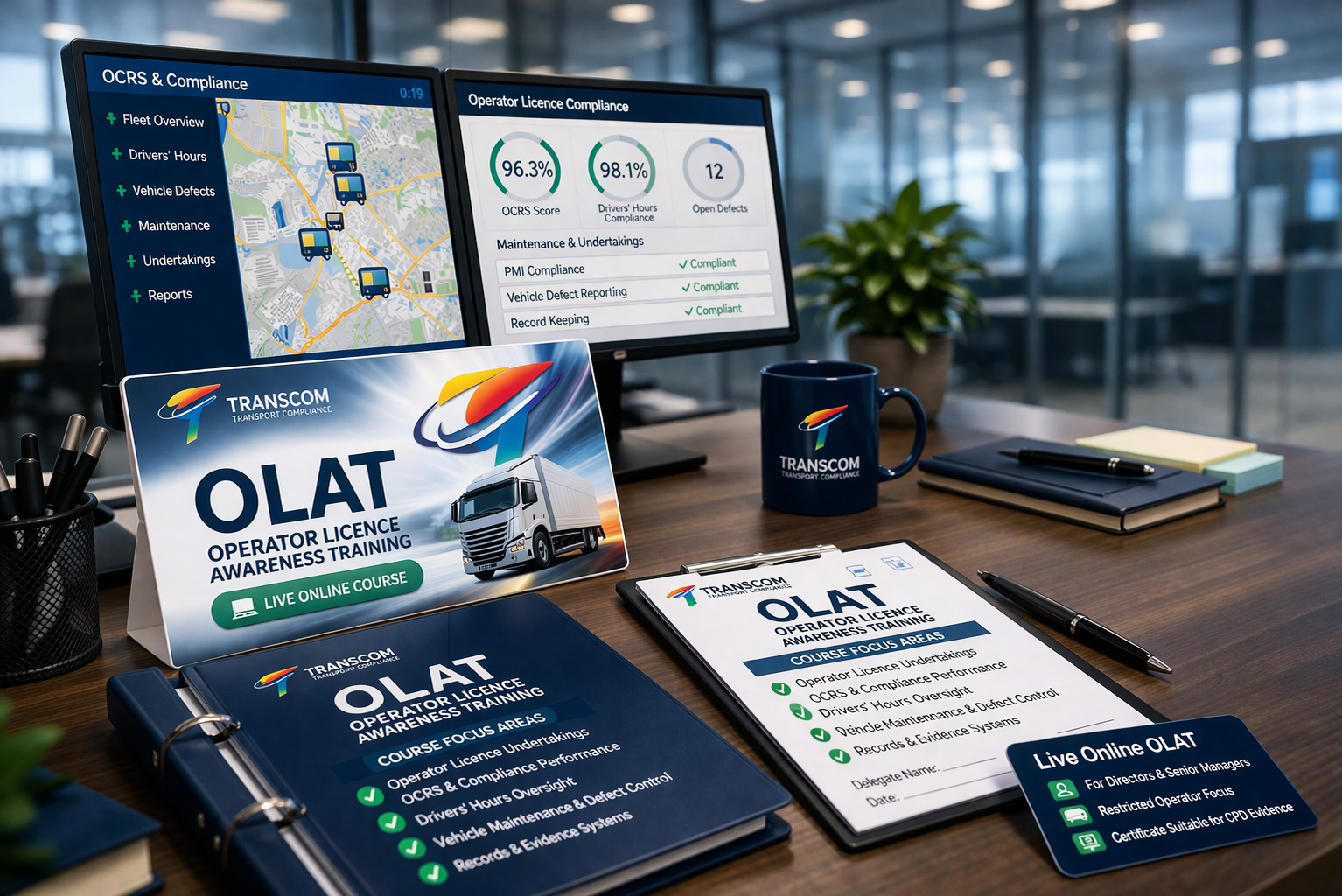
A 1-day live Zoom course for directors, senior managers and restricted operator licence holders. Also called an Operator Licence Management Course by the Traffic Commissioner.
Run by an approved Transport Manager CPC examination centre for goods vehicle and PSV licences — one of the provider types Traffic Commissioners accept for OLAT undertakings.
October Offer: £50 + VAT
£60 including VAT per delegate for live online courses taking place 1–31 October 2026, including Saturdays. The course date decides the price, not the booking date.
- Certificate accepted by every Traffic Commissioner it has been submitted to
- Meets the Traffic Commissioners' virtual OLAT criteria
- New Operator Guide (PDF) included
- Brake Test Trend Monitoring Spreadsheet included
- Weekday and Saturday dates — Saturdays at no extra cost
- Taught by people who have run transport operations
4.9★ Trustpilot | 5★ Google
Rated by verified delegates on independent review platforms.
Accepted Provider Type
Approved Transport Manager CPC examination centre for goods vehicle and PSV licences.
Tools You Keep
New Operator Guide (PDF) and Brake Test Trend Monitoring Spreadsheet included.
Saturdays, Same Price
Complete OLAT without taking time out of the working week.
View Upcoming OLAT Course Dates and Book Online
Choose a weekday or Saturday course below. Courses taking place in October 2026 cost £50 + VAT (£60 including VAT) per delegate, including Saturdays. Every booking includes 7 hours of live Zoom training, a certificate on completion, the New Operator Guide and the Brake Test Trend Monitoring Spreadsheet. For dates outside October, check the price on the individual booking page.
Upcoming Courses
Operator Licence Awareness Training (OLAT)
Operator Licence Awareness Training (OLAT)
Operator Licence Awareness Training (OLAT)
Operator Licence Awareness Training (OLAT)
Operator Licence Awareness Training (OLAT)
Operator Licence Awareness Training (OLAT)
Operator Licence Awareness Training (OLAT)
Operator Licence Awareness Training (OLAT)
Operator Licence Awareness Training (OLAT)
Operator Licence Awareness Training (OLAT)
Operator Licence Awareness Training (OLAT)
What's Included
You leave with evidence for the Traffic Commissioner and the tools to run a compliant operation from day one.
OLAT Certificate
Issued on completion as evidence of attendance at an Operator Licence Management Course. Accepted by every Traffic Commissioner it has been submitted to.
New Operator Guide
A PDF guide written for new operators, covering what you need in place to meet your licence undertakings. Print it or keep it on any device.
Brake Test Trend Monitoring Spreadsheet
Produced by Transcom. Track and record your fleet's braking performance and spot failing trends before DVSA does.
Not Every OLAT Course Will Satisfy Your Undertaking
When the Traffic Commissioner makes OLAT attendance a condition of an interim or full licence, the undertaking states which providers are acceptable. A course from anyone else may not count — and if suitable evidence is not submitted before an interim expires, you lose authority to operate.
Logistics UK, RHA, BAR or CPT.
IoTA, CILT, SOE or IRTE.
Transcom National Training is an approved Transport Manager CPC centre for both goods vehicle and PSV licences.
This is usFirms that have represented operators or Transport Managers at 20+ public inquiries in the past two years.
We Meet Every Traffic Commissioner Criterion
Virtual OLAT courses must satisfy criteria set by the Traffic Commissioners. Our course meets every one. Here is each criterion, and exactly how we meet it.
| Traffic Commissioner criterion | How we meet it |
|---|---|
| Instructor and all participants visible and audible to each other throughout | Cameras and microphones stay on for the whole course. Live Zoom classroom, not pre-recorded video. |
| Participation by tablet, laptop or PC with camera and microphone | Delegates are told before the course to join on a tablet, laptop or PC. Smartphones are not accepted. |
| Provider verifies every participant's identity before the course starts | Photo ID is checked before the course begins, using our secure ID upload. |
| Instructor can interact, display material and discuss it at the same time | Live tutor-led delivery with shared slides, worked examples and open discussion. |
| Replicates, as far as possible, a physical classroom course | Same content, structure and interaction as our classroom delivery. |
| An element of assessment to confirm active engagement | Knowledge checks during the day confirm each delegate has engaged with the content. |
| Total participation time in the region of 7 hours | 7 hours of live training — the full time is spent in the live classroom. |
Taught by People Who Have Run the Operation
New operators get support from trainers who have driven the vehicles, managed the fleets and dealt with the Traffic Commissioner. We understand the pressure you are under because we have been there.
Need help after the course? We also provide restricted operator compliance support and operator licence application assistance.
OLAT for Directors and Restricted Operator Licence Holders
Restricted operators often have no nominated Transport Manager, but the responsibilities do not go away. The business still needs systems for maintenance, defect reporting, drivers' hours, record keeping and compliance monitoring — and directors must understand them.
Where Restricted Operators Fall Short
- Weak or informal vehicle maintenance control.
- Defect reports not followed up or evidenced.
- Drivers' hours and tachograph data not monitored.
- Records kept but not actively checked.
- Directors unaware of their licence undertakings.
How OLAT Helps
- Clarifies who is responsible for what.
- Explains what evidence should exist.
- Explains OCRS and enforcement risk.
- Provides a certificate for licence applications and compliance files.
- Gives you the guide and spreadsheet to put systems in place.
OLAT for Operator Licence Applications
OLAT is not required for every application. Traffic Commissioners do request it — often as an interim licence undertaking — where there are concerns about an applicant's understanding, compliance history or ability to manage the licence.
Published Traffic Commissioner Decisions Involving OLAT
Sukhvinder Singh
Completion of an OLAT course from a competent and independent provider referred to as part of future application evidence. Read decision
Premier Scaffolding
Applicant advised to undertake Operator Licence Awareness Training before a further application. Read decision
R A Wood Pallet's Recycling Ltd
All directors advised to attend an OLAT course before launching a fresh application. Read decision
What Does the OLAT Course Cover?
Compliance Responsibilities
- Operator undertakings: what they mean and how to evidence them.
- OCRS: how compliance performance drives regulatory attention.
- Drivers' hours: oversight, monitoring and infringement follow-up.
- Maintenance: PMI planning, defects, roadworthiness and brake testing.
- Record control: what to retain and how to check it.
Practical Outcomes
- Clear control: who checks what, and when.
- Better evidence: records that stand up to scrutiny.
- Known risk points: where your operation is exposed.
- Stronger oversight: less reliance on assumptions.
- Certificate evidence for the Traffic Commissioner.
Who Should Attend?
Typical Delegates
- Directors of new and existing operators.
- Applicants with an OLAT undertaking on an interim licence.
- Restricted licence holders without a qualified Transport Manager.
- Senior managers overseeing fleet, maintenance or transport systems.
- Compliance staff handling records, audits and defect reporting.
When This Course Helps Most
- When the Traffic Commissioner has requested OLAT attendance.
- Before an interim licence expires.
- After DVSA contact such as prohibitions, warnings or OCRS pressure.
- When responsibility moves to new directors or managers.
- Before an audit or public inquiry.
Delegate Feedback
★★★★★
Couldn't Be Happier with the Experience
Excellent training course delivered by highly skilled and knowledgeable staff. The course was well structured, and the delivery was outstanding. All my questions were answered promptly and thoroughly.
— Yvonne Finnigan
GB • 8 September 2026
★★★★★
Fantastic Course!
Gareth delivered the OLAT course with energy and professionalism. I came away having learnt more than I thought I would. I can now move into my new venture with much more confidence!
— Andrew Chaplin
GB • January 2026
★★★★★
Gareth Made It Genuinely Enjoyable
I attended the OLAT course online last week. This was my first introduction to the subject and I have to say Gareth made it interesting and dare I say enjoyable and the day flew by. I'd recommend without reservation.
— David Gregory
GB • 15 June 2026
Frequently Asked Questions
Will my certificate satisfy my Traffic Commissioner undertaking?
Our certificate has been accepted by every Traffic Commissioner it has been submitted to. Transcom is an approved Transport Manager CPC examination centre for goods vehicle and PSV licences — one of the provider types listed in standard OLAT undertakings — and our online course meets every one of the Traffic Commissioners' virtual course criteria.
How quickly do I need to send my certificate?
Standard undertakings require proof of attendance to be sent to the Office of the Traffic Commissioner (Licensing) within seven days of completing the course, and before your interim expires. You will not be sent reminders, so book early.
Is this the same as an Operator Licence Management Course?
Yes. The Traffic Commissioner refers to this training as an Operator Licence Management Course. It is the same course.
How much does the OLAT course cost?
For courses taking place 1–31 October 2026, the price is £50 + VAT (£60 including VAT) per delegate, including Saturdays. The course date decides the price, not the booking date. For other dates, see the individual course listing.
What is included?
7 hours of live tutor-led training, a certificate on completion, the New Operator Guide (PDF) and the Brake Test Trend Monitoring Spreadsheet produced by Transcom.
What equipment do I need?
A tablet, laptop or PC with a working camera and microphone. The Traffic Commissioners' criteria do not accept smartphones, and you must keep your camera on throughout.
Do I need to provide ID?
Yes. The Traffic Commissioners' criteria require us to verify your identity before the course starts. Upload photo ID through our secure document upload after booking.
Is there an assessment?
There is no formal exam. Knowledge checks during the day confirm you have engaged with the course, as the Traffic Commissioners' criteria require.
Is OLAT available on a Saturday?
Yes. We run regular weekday and Saturday courses live on Zoom, and Saturdays cost the same as weekdays.
Is OLAT required for every operator licence application?
No. It is requested where the Traffic Commissioner needs evidence that the people responsible for the licence understand their obligations, often as a condition of an interim licence.
Is OLAT the same as Transport Manager CPC or Driver CPC?
No. OLAT is management-level awareness training. The Transport Manager CPC is a formal professional qualification, and OLAT does not count towards Driver CPC periodic training.
Can you deliver OLAT on site?
Yes. On-site OLAT for employer groups can be arranged nationwide, subject to location, delegate numbers and availability.
Operator Compliance Resources

Skills and Education Group Awards Approved Centre
Transcom National Training is an approved Transport Manager CPC examination centre for Skills and Education Group Awards, an Ofqual-regulated awarding body, offering the qualification for both goods vehicle and PSV licences. That places us in one of the provider categories listed in standard Traffic Commissioner OLAT undertakings.
Book Your 1-Day OLAT Course Online
7 hours of live training from an accepted provider type, with weekday and Saturday dates. You get a certificate for the Traffic Commissioner, the New Operator Guide and the Brake Test Trend Monitoring Spreadsheet. October 2026 courses cost £50 + VAT (£60 including VAT) per delegate.