An operator licence can be put at risk long before a formal investigation begins. Missed maintenance intervals, weak defect reporting, unchecked driver hours or a lack of documented management control can all point to the same issue: the operator does not have effective systems in place. Operator licence awareness training online gives directors, licence holders and transport managers the practical understanding needed to recognise those risks early and act on them.
Why operator licence awareness matters
Holding an operator licence brings continuing legal and professional responsibilities. The licence is not simply permission to run vehicles. It is a public commitment that the business will operate lawfully, maintain vehicles properly, manage drivers effectively and retain the evidence needed to demonstrate control.
That responsibility does not sit with one person alone. A nominated Transport Manager must exercise continuous and effective management of the transport operation, but directors and licence holders must also provide the authority, resources and support needed for compliance to work in practice. Where responsibility is poorly understood, problems can be passed between departments until they become serious.
Awareness training addresses this gap. It explains the licence undertakings in operational terms and helps people understand what the Traffic Commissioner is likely to expect to see if concerns are raised. This is particularly valuable for new operators, growing fleets, businesses bringing transport management in-house and directors who rely on others for day-to-day fleet control.
What operator licence awareness training online should cover
Effective training should be grounded in the realities of operating HGV, LGV or PCV vehicles. It should not treat compliance as a collection of policies that can be filed away and forgotten. Participants need to understand the purpose of each system, who owns it and what records prove it is being followed.
A well-structured course will normally cover the operator licence undertakings, the role and responsibilities of licence holders and Transport Managers, vehicle maintenance arrangements, daily walkaround checks, defect reporting and rectification, and the management of drivers' hours, working time and tachograph records.
It should also address the wider control environment. This includes checking driving licence entitlement, managing agency and temporary drivers, monitoring prohibitions and collisions, responding to changes in the operating centre or vehicle authority, and keeping the business information on the licence accurate. The detail required will depend on the operation, but the standard remains the same: controls must be suitable, used consistently and evidenced.
For directors, the most useful outcome is often a clearer understanding of the questions they should be asking. Are maintenance providers being monitored against agreed standards? Are defects analysed for repeat issues? Does the Transport Manager have enough time, authority and access to records? Are internal reviews identifying failures before an external audit does?
Evidence is part of compliance
A compliance process that cannot be demonstrated may be difficult to defend. Training should therefore connect every duty to its evidence trail. A daily check needs a completed record, reported defects need action and closure, maintenance needs forward planning and completed inspection documentation, while tachograph analysis needs follow-up where infringements occur.
This does not mean creating paperwork for its own sake. It means being able to show that decisions are controlled, exceptions are investigated and recurring risks are dealt with. A folder of blank forms is not a compliance system. Neither is software that produces reports no one reviews.
Why choose online delivery?
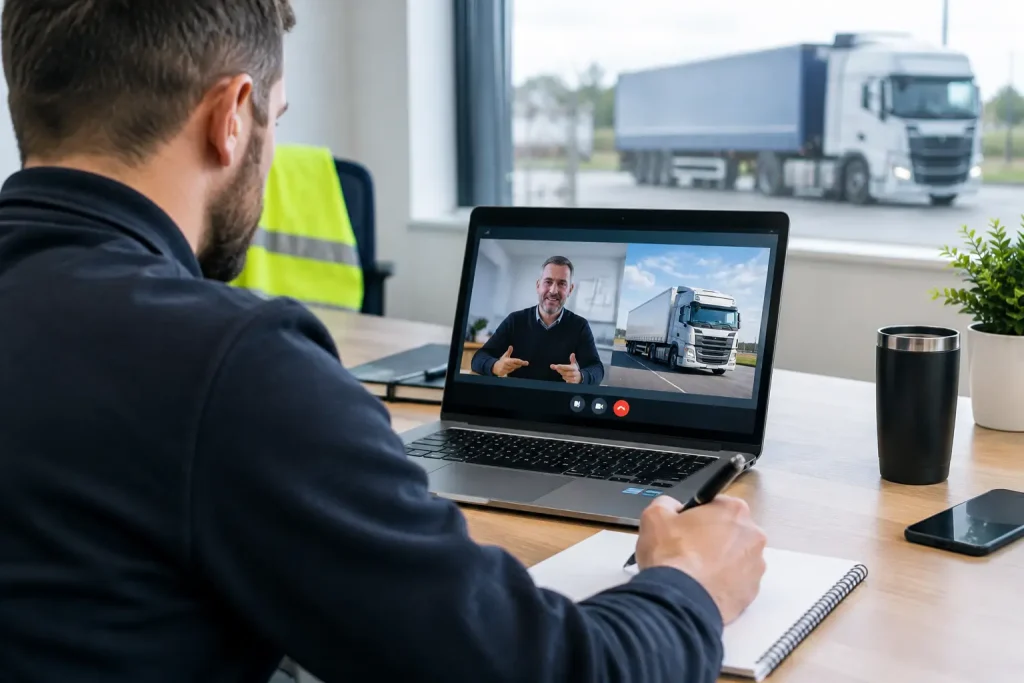
Operator licence awareness training online can be the most practical route for busy operators, particularly where directors, managers and administrative staff are based at different sites. Live tutor-led sessions allow participants to learn without unnecessary travel or time away from the operation, while still giving them the opportunity to ask questions about real working arrangements.
The quality of delivery matters. A pre-recorded module may suit a basic induction requirement, but it cannot test whether a participant understands how a licence undertaking applies to their fleet. Live training is stronger where the tutor can challenge assumptions, explain common audit findings and clarify the difference between a written procedure and a system that is genuinely working.
Online learning also requires discipline. Participants should join from a suitable environment, engage with the session and have time to consider how the content applies to their own responsibilities. If somebody is expected to answer calls, monitor vehicles and complete training at the same time, the business is unlikely to gain the intended benefit.
Training is not a substitute for management control
Awareness training is an essential foundation, but it is not a one-off fix for an operation with weak systems. If records are incomplete, inspection intervals are missed or responsibilities are unclear, the next step may be a structured compliance review rather than more classroom learning alone.
The right approach depends on the scale and condition of the business. A new operator may need help setting up maintenance agreements, reporting routes and document controls from the outset. A long-established fleet may instead need an independent health check to test whether existing processes are still being followed as the operation has changed.
Training becomes most valuable when it leads to action. Following a course, a director might introduce regular compliance meetings with documented actions. A Transport Manager may revise the escalation route for overdue vehicle inspections. An office team may take ownership of licence checks and filing standards. These are practical improvements that help protect the operator licence.
The role of directors and licence holders
Directors do not need to perform every operational task personally. They do, however, need sufficient knowledge to appoint capable people, resource the transport function and challenge performance when warning signs appear. Delegating a task does not remove the underlying responsibility to ensure it is being done properly.
Particular care is needed where the nominated Transport Manager is part-time, external or responsible for more than one site. The arrangement must allow genuine, continuous involvement in the operation. That means access to maintenance documentation, driver records, tachograph analysis, incident information and management decision-making. A name on an application form is not enough.
Licence holders should also understand the importance of early action. If a key person leaves, financial standing changes, a maintenance provider fails or the operating centre becomes unsuitable, delaying a response can make a difficult position worse. Knowing when to seek specialist support is part of responsible management.
Choosing the right course for your business
Before booking, consider who needs to attend and why. An owner-operator may need a broad overview of the undertakings and daily controls. A director may need focused awareness of governance, oversight and resource decisions. A newly appointed Transport Manager may benefit from a more detailed route that builds role readiness alongside formal knowledge.
Look for training delivered by specialists who understand operator licensing, enforcement expectations and the evidence behind good practice. The course should use realistic transport examples rather than generic compliance language. It should also make clear where the law sets a minimum requirement and where a sensible operator should apply additional control because of the fleet's size, risk profile or operating pattern.
Transcom National Training provides specialist, live tutor-led support designed around the practical responsibilities of road transport operators. The focus is not on box-ticking. It is on helping the right people understand what lawful, controlled operation looks like and how to maintain it.
Put learning into practice straight away
The strongest next step after training is to review one area of the operation while the learning is fresh. Choose a process with a clear evidence trail, such as defect reporting, maintenance planning or tachograph infringement follow-up. Check whether the written process is current, whether staff understand it, whether records are complete and whether management reviews exceptions.
Small gaps identified early are usually manageable. Left unchallenged, they can become patterns that are difficult to explain to an auditor or Traffic Commissioner. Operator licence awareness is therefore not merely about knowing the rules. It is about developing the judgement to spot when the operation is drifting from them, and the confidence to correct it before the licence is exposed.