

Build a CPC Exam Revision Timetable That Works
Build a CPC exam revision timetable that turns the Transport Manager syllabus into confident, structured preparation for examination day with purpose.
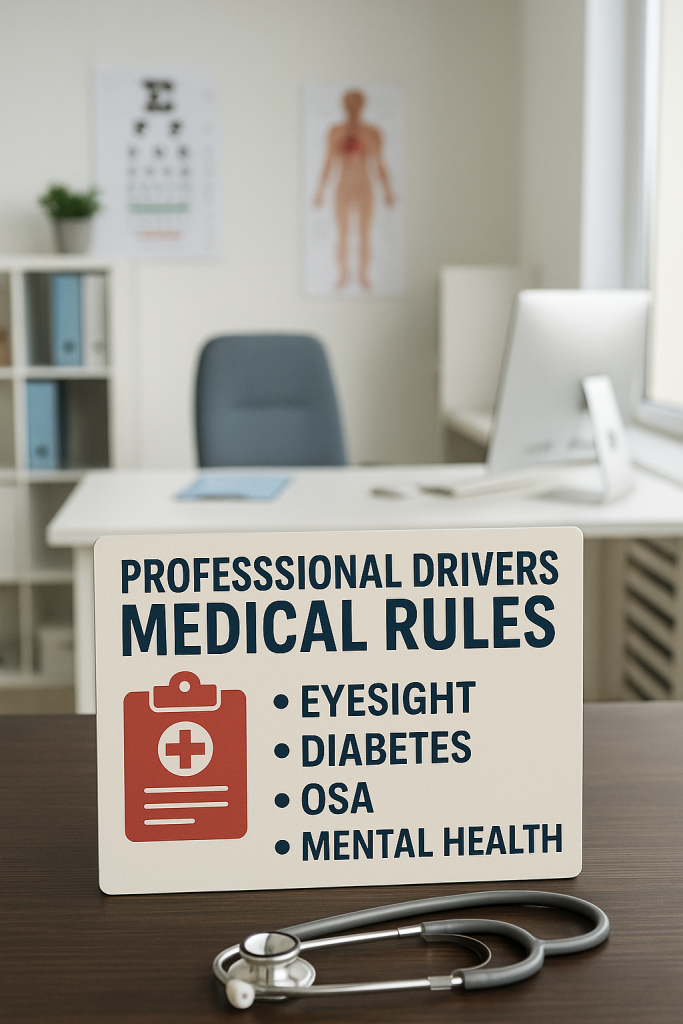
If you drive a lorry, bus or coach for work, your Group 2 licence depends on more than your driving ability. Eyesight, diabetes control, sleep disorders, heart conditions, mental health and medication can all affect whether you are legally fit to drive.
This guide explains the key DVLA medical rules professional drivers need to understand in 2026, including the major change allowing eligible Group 2 drivers with diabetes to use Continuous Glucose Monitoring systems while driving.
Last reviewed: May 2026Important: this article is a practical guide for professional drivers and transport operators. It is not medical advice and it is not a substitute for the official DVLA medical standards or advice from a doctor, optician, diabetes specialist or other healthcare professional.
This guide focuses on DVLA rules for Great Britain. Drivers in Northern Ireland should check the relevant DVA medical guidance and reporting process.
Lorry, bus and coach drivers are held to stricter medical standards than car drivers.
Eligible Group 2 drivers with diabetes may now use approved CGM systems while driving.
Visual acuity, field of vision and corrective lens rules are all important.
Hiding a notifiable condition can put your licence, insurance and livelihood at risk.
From 7 November 2025, DVLA updated the diabetes rules so that bus, coach and lorry drivers with diabetes can use modern glucose monitoring technology, including Continuous Glucose Monitoring systems, where the driver meets the relevant medical and licensing criteria.
This is a major change for professional drivers with insulin-treated diabetes, but it does not remove the responsibility to monitor properly, carry backup equipment or stop driving when glucose levels are unsafe.
Do not drive if your glucose level is 4.0 mmol/L or below. If your glucose is between 4.0 mmol/L and 5.0 mmol/L, take a fast-acting carbohydrate snack, such as glucose tablets, sweets or a sugary drink.
If you experience low glucose while driving, stop safely as soon as possible, switch off the engine, remove the keys and do not drive again until at least 45 minutes after your glucose has returned to 5.0 mmol/L or above. That waiting period matters because reaction time and brain function need time to recover.
Drivers with insulin-treated diabetes must tell DVLA. For Group 2 drivers, DVLA applies strict standards because a hypo behind the wheel of a lorry, bus or coach can have serious consequences.
If a Group 2 driver starts insulin, they must usually stop driving Group 2 vehicles until DVLA has made a licensing decision. Do not guess. Check the DVLA diabetes guidance and speak to your clinician.
Diabetes does not automatically mean a driver cannot hold a Group 2 licence. However, the position depends on the treatment, risk of hypoglycaemia, complications and whether the driver meets the DVLA medical standard.
Diabetes complications can also matter. Visual field defects, impaired awareness of hypoglycaemia, neuropathy, renal problems or other complications may affect the licensing decision.
Professional drivers should not leave medical renewals until the last minute. If your Group 2 entitlement expires or your medical application is incomplete, your ability to work can be affected.
| Stage | What usually happens | Practical point for drivers |
|---|---|---|
| First Group 2 application | A D4 medical examination report is required when applying for a lorry or bus licence. | Arrange the medical before you need the entitlement. An incomplete D4 can delay the application. |
| At age 45 | A D4 medical is required when renewing Group 2 entitlement at 45. | Do not ignore the renewal reminder. Your vocational entitlement depends on it. |
| Age 45 to 64 | A D4 medical is normally required every 5 years. | Book early, especially if you need an optician to complete the vision section. |
| Age 65 and over | Group 2 renewal becomes annual. | Annual renewal means annual planning. Put the date in your diary and do not rely on memory. |
The D4 is the medical examination report used for Group 2 lorry and bus licensing. You can download it from the official D4 medical examiner report page on GOV.UK.
Drivers often treat the D4 as a paperwork exercise. It is not. The D4 is where eyesight, blood pressure, heart history, diabetes, sleep disorders, psychiatric history, neurological conditions, medication and substance misuse can all become licensing issues.
Eyesight is one of the biggest risks for professional drivers because Group 2 standards are stricter than ordinary car standards. Passing a basic number plate check is not enough on its own for Group 2 entitlement.
Group 2 applicants must normally have, using the 6 metre Snellen chart:
This may be achieved with or without glasses or contact lenses. However, if glasses are worn for driving, the corrective power of either lens must not be greater than +8 dioptres in any meridian.
The Group 2 visual field standard normally requires:
Some older Group 2 licence holders may fall under older eyesight provisions. However, drivers should not assume they are protected just because they passed a test years ago or hold older categories.
Older eyesight provisions depend on the exact entitlement held, the date it was held, whether the driver is renewing rather than applying for new entitlement, and whether the driver can still meet the required criteria. If your sight has changed, get proper advice before relying on old entitlement.
Monocular vision warning: drivers with sight in only one eye, or whose sight in one eye has deteriorated below the relevant threshold, cannot normally be licensed for Group 2 vehicles unless a strict exception applies.
Obstructive Sleep Apnoea Syndrome can cause excessive daytime sleepiness, poor concentration and microsleeps. For a professional driver, that is not a minor health issue. It is a direct road safety issue.
You must tell DVLA if you have confirmed moderate or severe obstructive sleep apnoea syndrome with excessive sleepiness, or another sleep condition that causes excessive sleepiness. You must not drive until the sleepiness is controlled and you are following any required treatment.
For many drivers, treatment such as CPAP can allow a return to driving once symptoms are controlled and treatment adherence can be shown. The key point is simple: uncontrolled sleepiness and professional driving do not mix.
Official guidance: DVLA guidance on excessive sleepiness and driving.
If you drive a bus, coach or lorry and you have had a heart attack, cardiac angioplasty or coronary angioplasty, you must tell DVLA and stop driving for 6 weeks. You must then be assessed by a doctor or GP to see whether you meet the medical standard to drive again. DVLA may arrange further tests depending on your condition.
Official guidance: heart attacks, angioplasty and driving.
For bus, coach and lorry drivers, you do not need to tell DVLA if your blood pressure is consistently below 180/100 mmHg. However, you must stop driving and tell DVLA if your blood pressure is consistently above that level, or if a doctor says you have malignant hypertension.
Official guidance: high blood pressure and driving.
Mental health does not automatically prevent a professional driver from holding a Group 2 licence. The real issue is whether the condition, symptoms, relapse risk, medication or side effects could affect safe driving.
Mild to moderate anxiety or depression may not need to be notified if there are no significant concentration, memory, agitation, behavioural or suicidal concerns. Severe anxiety, severe depression, psychosis, mania, cognitive impairment or medication side effects can trigger stricter rules and may require DVLA notification.
It is illegal to drive in England, Scotland and Wales with certain drugs in your body above specified limits unless a legal defence applies. You may be able to drive after taking prescribed medication if:
That last point is the one drivers must not ignore. If medication makes you drowsy, dizzy, slow to react, confused or unable to concentrate, do not drive. A prescription is not a licence to drive impaired.
Medicines that may be relevant include some benzodiazepines, opioid-based painkillers, methadone, morphine, clonazepam, diazepam, lorazepam, oxazepam and temazepam. Speak to your doctor or pharmacist if you are unsure.
Official guidance: drugs and driving: the law.
In some cases, Section 88 of the Road Traffic Act 1988 may allow a driver to continue driving while DVLA processes a valid application. However, drivers should be careful. Section 88 is not a blanket permission to carry on regardless.
You must meet the Section 88 criteria, your application must be correct and complete, and your current medical condition must not bar you from driving. For lorry and bus drivers, your Group 2 entitlement must not have been suspended, revoked or refused by a Traffic Commissioner.
If your licence was revoked or refused for medical reasons, you must wait for DVLA to reissue a new licence before driving again.
Official guidance: Can I drive while my application is with DVLA?
If you are relying on Section 88, get advice from your doctor or healthcare professional, keep evidence of your application, check the official DVLA guidance and make sure the vehicle category you intend to drive is covered. If in doubt, do not drive until you have clarity.
Medical fitness is not only a driver issue. Operators and transport managers should have systems in place to manage driver fitness to drive, licence entitlement and medical declarations.
A good operator should be able to show evidence of:
For transport managers and operators, this is where Driver CPC, Operator Licence Awareness Training and Transport Manager Refresher training all connect. Medical compliance is part of the wider duty to operate safely, legally and professionally.
Yes, eligible Group 2 drivers can now use Continuous Glucose Monitoring systems for glucose checks while driving, provided they meet the DVLA medical and monitoring requirements. They must still carry suitable backup equipment.
Yes. Drivers using CGM must keep a finger-prick monitor as backup and use it if the CGM device or sensor is not working, or if the reading does not match how they feel.
You must not drive if your glucose level is 4.0 mmol/L or below. If it drops while driving, stop safely, treat the hypo and wait at least 45 minutes after glucose returns to 5.0 mmol/L or above before driving again.
A D4 is required for a first Group 2 lorry or bus licence application, at age 45, every 5 years from 45 to 65, and annually from age 65. Other situations may also require a D4, including some medically restricted licences and new provisional Group 2 entitlement applications.
Possibly, under Section 88, but only if you meet all the criteria. Your application must be correct and complete, you must be medically fit to drive, and your entitlement must not have been suspended, revoked or refused where that prevents you driving.
For a bus, coach or lorry licence, you do not need to tell DVLA if your blood pressure is consistently below 180/100 mmHg. You must stop driving and tell DVLA if it is consistently above 180/100 mmHg or if a doctor says you have malignant hypertension.
Yes. Even if medication is legally prescribed, you must not drive if it makes you unfit to drive. Side effects such as drowsiness, poor concentration, dizziness or slowed reaction time can make driving unsafe.
You must tell DVLA if you have confirmed moderate or severe obstructive sleep apnoea syndrome with excessive sleepiness, or another sleep condition causing excessive sleepiness. You must not drive until symptoms are controlled and treatment is being followed.
For professional drivers, medical fitness is not just a personal health issue. It affects your licence, your Driver CPC, your employment and your operator’s compliance position.
Transcom National Training provides live online Driver CPC training and transport compliance courses for drivers, transport managers and operators across the UK.
Information note: This guide is based on official DVLA and GOV.UK medical guidance available at the time of review. Medical licensing rules can change, and individual cases depend on personal medical circumstances. Always check the official guidance and speak to a suitable healthcare professional if you are unsure whether a condition affects your fitness to drive.
Official sources include: DVLA diabetes fitness to drive guidance, D4 medical report guidance, visual disorders fitness to drive guidance, and Section 88 DVLA guidance.
Build a CPC exam revision timetable that turns the Transport Manager syllabus into confident, structured preparation for examination day with purpose.

Operator licensing is not a formality. See how licence type, undertakings, transport management and evidence help protect a lawful UK fleet every day.

Transport compliance protects more than paperwork. Build evidence, control risk and meet operator licence duties with practical, accountable systems daily.

A practical guide to transport manager appointment: eligibility, operator licence steps, legal duties and evidence needed for compliant daily operations.

Internal versus external transport manager: assess control, cost, competence and licence risk before choosing the right arrangement for your fleets.

Understand DVSA investigation triggers, the evidence examiners may seek, and the practical controls that help operators protect their licence and standing.
|
Uploaded
Failed
|
 |