Driver compliance guide
Working Time Rules for UK Drivers and Operators: WTR, RTWTR, Drivers’ Hours and AETR Explained
A practical guide for HGV drivers, PCV drivers, transport managers and operators who need to understand working time, driving time, breaks, rest periods and record keeping.
Reviewed April 2026
HGV & PCV compliance
Drivers’ hours
Working time records
Author: Gareth Wildman — Director & Senior Lead Instructor, Transcom National Training.
If you drive professionally or run a transport operation in the UK, working time rules are not optional. The difficulty is that there is more than one set of rules, and they do not all measure the same thing.
Many drivers and operators use the phrase “Working Time Directive” as a catch-all term. That causes confusion. In practice, you need to understand the difference between general working time law, road transport working time rules, and drivers’ hours rules.
Plain-English warning: following drivers’ hours rules does not automatically mean you have complied with working time rules. Driving time and working time are related, but they are not the same thing.
The Three Rule Sets You Need to Understand
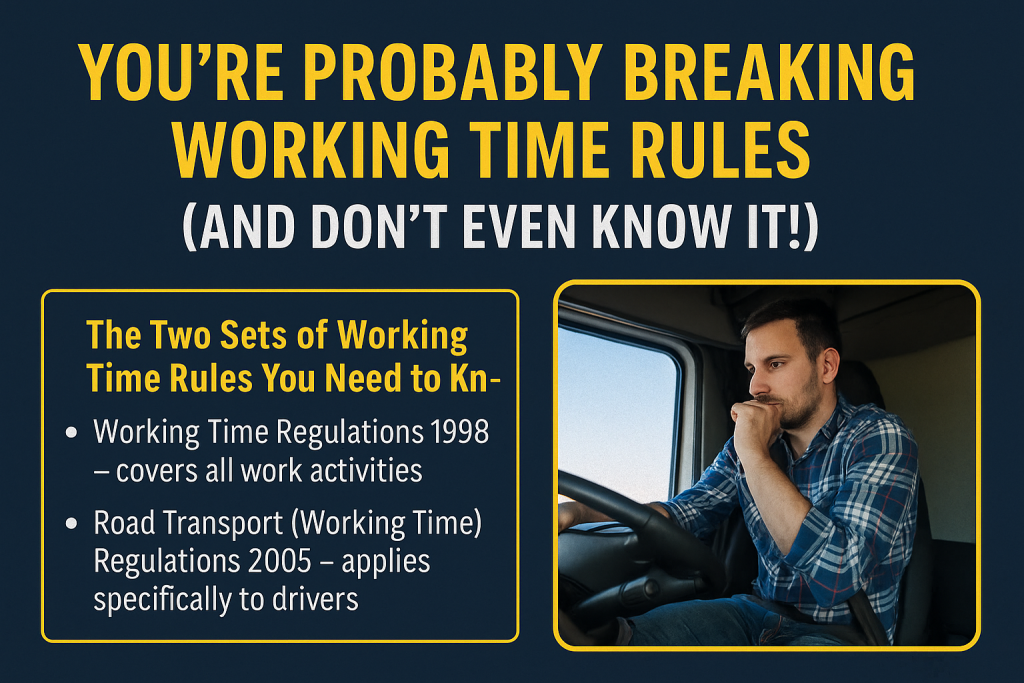
1. Working Time Regulations 1998
These are the general UK working time rules. They cover areas such as weekly working time, rest, night work and paid annual leave for many workers.
For road transport, they matter most where a person is not covered by the transport-specific mobile worker rules.
2. Road Transport Working Time Regulations 2005
These are the transport-specific working time rules for mobile workers involved in operations covered by assimilated drivers’ hours rules or AETR.
They cover working time, breaks from work, night work and record keeping.
3. Drivers’ Hours and AETR Rules
These rules control driving time, breaks from driving, daily rest, weekly rest and tachograph records.
They are not the same as working time rules, even though both sets of rules often apply to the same driver.
Which Rules Apply to HGV and PCV Drivers?
GOV.UK explains that assimilated drivers’ hours rules apply to most goods vehicles where the vehicle or vehicle combination has a maximum permissible weight over 3.5 tonnes and is used in the UK or between the UK and EU. AETR rules apply to many international journeys that are not wholly between the UK and EU and involve AETR countries.
| Rule area |
What it controls |
Common example |
| Working Time Regulations 1998 |
General working time protections such as weekly working time, rest and annual leave. |
Workers not covered by the transport-specific mobile worker rules. |
| Road Transport Working Time Regulations 2005 |
Total working time, breaks from work, night work and working time records for mobile workers. |
HGV or PCV drivers and crew working in scope of assimilated drivers’ hours or AETR. |
| Assimilated drivers’ hours rules |
Driving time, breaks from driving, daily rest, weekly rest and tachograph rules. |
Most HGV operations over 3.5 tonnes in the UK or between the UK and EU. |
| AETR rules |
International drivers’ hours rules for journeys involving AETR countries. |
International journeys outside the normal UK/EU assimilated rules route pattern. |
Road Transport Working Time Rules: The Key Limits
For mobile road transport workers, the Road Transport Working Time Regulations 2005 control total working time. This is not just time spent driving. It can include loading, unloading, vehicle checks, cleaning, maintenance, paperwork, assisting passengers, and waiting time where the driver cannot freely use the time.
Core RTWTR points
- Maximum weekly working time: up to 60 hours in a single week.
- Average weekly working time: must not exceed 48 hours over the relevant reference period, commonly 17 weeks, or up to 26 weeks where permitted.
- Breaks from work: working time must be interrupted by breaks where the driver’s working period exceeds 6 hours.
- Night work: night work is limited unless a relevant agreement allows otherwise.
- No casual opt-out: operators should not assume a driver can simply opt out of the road transport working time rules.
Common mistake: a driver may be legal on driving time but illegal on working time. For example, long periods of loading, waiting, cleaning or other work can push the driver over working time limits even if driving hours look acceptable.
Working Time Breaks vs Driving Breaks
This is one of the biggest areas of confusion. A working time break and a drivers’ hours driving break are not always the same thing.
| Type of break |
What it relates to |
Why it matters |
| Working time break |
Total work, including driving and other duties. |
Prevents mobile workers from working too long without a break. |
| Drivers’ hours break |
Driving time. |
Controls how long a driver can drive before taking a qualifying break. |
| Daily or weekly rest |
Rest away from work and driving duties. |
Protects driver recovery and helps prevent fatigue. |
In simple terms, plan both. Do not plan a route only around driving time and then forget loading, unloading, yard time, vehicle checks, paperwork and other work.
What Counts as Working Time?
Working time is broader than driving time. For road transport workers, it may include:
- driving;
- loading and unloading;
- vehicle checks and defect reporting;
- cleaning and maintenance duties;
- paperwork and transport administration;
- assisting passengers or customers;
- waiting time where the driver cannot freely use the time;
- work carried out for another employer.
Driver responsibility: drivers should tell their employer or agency about work done elsewhere, so total working time can be monitored properly.
Working Time Records: What Operators Should Keep
Operators need reliable records to show how working time is monitored. Tachograph data may help, but it does not automatically prove every working time duty unless activities are recorded correctly.
Records may include tachograph downloads, manual entries, timesheets, duty rosters, agency declarations, holiday records, sickness records and written working time agreements where relevant.
Operators should check:
- whether drivers are recording other work correctly;
- whether agency or part-time drivers have declared other employment;
- whether working time is monitored across the reference period;
- whether night work is controlled;
- whether breaks are planned realistically;
- whether records are available if requested or investigated.
Why Working Time Compliance Matters
Poor working time control creates more than an admin problem. It can create fatigue risk, enforcement risk, employment risk and operator licence risk.
- Driver fatigue: excessive working time increases the risk of mistakes and collisions.
- DVSA enforcement: poor records can make it harder to prove compliance.
- Operator licence risk: weak systems can raise questions about management control.
- Employment risk: drivers may have rights to records, rest and fair treatment.
- Commercial risk: poor scheduling can damage contracts, reputation and insurance confidence.
Transport manager point: a legal-looking schedule on paper is not enough. You need evidence that the work can be done safely, legally and consistently.
Working Time Rules Checklist for Drivers and Operators
For drivers
- Know whether you are under general WTR, RTWTR, assimilated drivers’ hours or AETR.
- Record driving, other work, availability, breaks and rest accurately.
- Use manual entries correctly when away from the vehicle.
- Tell your employer about work done for another employer.
- Do not rely on “the tachograph will sort it” if activities are recorded incorrectly.
For operators and transport managers
- Monitor working time over the relevant reference period.
- Check night work and break compliance.
- Train drivers on the difference between driving time and working time.
- Check agency and part-time driver declarations.
- Keep working time evidence ready for audit or investigation.
- Review schedules that regularly rely on maximum hours.
Need Help Understanding Drivers’ Hours and Working Time?
Transcom National Training delivers live online Driver CPC and transport compliance training for professional drivers and operators across the UK. Our training helps drivers understand not just the rule, but how it works in real operations.
References and Further Reading
Working Time Rules FAQs
Are working time rules the same as drivers’ hours rules?
No. Working time rules control total work, including driving and other duties. Drivers’ hours rules control driving time, breaks from driving, rest periods and tachograph requirements.
Does loading and unloading count as working time?
Yes. Loading, unloading, vehicle checks, cleaning, paperwork and other duties can count as working time, even if the driver is not driving.
Can a driver be legal on driving hours but illegal on working time?
Yes. A driver may stay within driving limits but still exceed working time limits because of other duties such as loading, waiting, checks or paperwork.
Do agency drivers need to declare work done elsewhere?
Yes. Drivers should inform employers or agencies about other work so total working time can be monitored correctly.
Why should operators monitor working time records?
Operators need evidence that drivers are being scheduled legally and safely. Poor working time control can create fatigue risk, DVSA enforcement risk and operator licence compliance risk.